


Book Shorts: Sales, Sales, Sales, Sales, Sales
Book Shorts: Sales, Sales, Sales, Sales, Sales
Jeffrey Gitomer’s Little Red Book of Selling and Little Red Book of Sales Answers were great refreshers in sales basics for you as CEO (and head of sales, and sales manager, and sales rep). The books were a bit “self-help” flavor for my taste as a reader, but they were excellent on content, and I have two long pages of notes of “back to basics” items I need to remind myself and my team about.
Anyone at Return Path in sales/account-project management/marketing — your copy is on the way, hopefully by way of a barter I proposed with the author (sorry, Stephanie and Tami…), but in any case, we’ll buy them. Anyone else who is interested at RP, let me know, and the copy is on me.
Some of the most critical reminders — although you have to read the books to get to get the color:
– Ask questions, don’t talk talk talk at prospects (just like the SPIN Selling methodology we always train with at Return Path)
– Never say “tell me a little bit about your business” — do the research first
– Importance of testimonials in selling
– Never blame others or blame circumstances when things go wrong. Take control and solve the problem (good for sales and for everyone!)
Reboot – Where do a company’s Values come from, and where do they go?
I’ve written a lot over the years about Return Path’s Core Values (summary post with lots of links to other posts here). And I’ve also written and believe strongly that there’s a big difference between values, which are pretty unchanging, and culture, which can evolve a lot over time. But I had a couple conversations recently that led me to think more philosophically about a company’s values.
The first conversation was at a recent dinner for a group of us working on fundraising for my upcoming 25th reunion from Princeton. Our guest speaker was a fellow alumnus who I’ve gotten to know and respect tremendously over the years as one of the school’s most senior and influential volunteer leaders. He was speaking about the touchstones in his life and in all people’s lives — things like their families, their faith, the causes they’re passionate about, and the institutions they’ve been a part of. I remember this speaker giving a similar set of remarks right after the financial crisis hit in early 2009. And it got me thinking about the origins of Return Path’s values, which I didn’t create on my own, but which I obviously had a tremendous amount of influence over as founder. Where did they come from? Certainly, some came from my parents and grandparents. Some came from my primary and secondary education and teachers. Some came from other influences like coaches, mentors, and favorite books. Although I’m not overly observant, some certainly came from Hebrew school and even more so from a deep reading of the Bible that I undertook about 15 years ago for fun (it was much more fun than I expected!). Some came from other professional experiences before I started Return Path. But many of them either came from, or were strongly reinforced by my experience at Princeton. Of the 15 values we currently articulate, I can directly tie at least seven to Princeton: helpful, thankful, data-driven, collaborative, results-oriented, people first, and equal in opportunity. I can also tie some other principles that aren’t stated values at Return Path, but which are clearly part of our culture, such as intellectually curious, appreciative of other people’s points of view, and valuing an interdisciplinary approach to work.
As part of my professional Reboot project, this was a good reminder of some of the values I know I’ve gotten from my college experience as a student and as an alumni, which was helpful both to reinforce their importance in my mind but also to remember some of the specifics around their origins – when and why they became important to me. I could make a similar list and trade and antecedents of all or at least most of our Company’s values back to one of those primary influences in my life. Part of Reboot will be thinking through all of these and renewing and refreshing their importance to me.
The second conversation was with a former employee who has gone on to lead another organization. It led me to the observation I’ve never really thought through before, that as a company, we ourselves have become one of those institutions that imprints its values into the minds of at least some of its employees…and that those values will continue to be perpetuated, incorporated, and improved upon over time in any organization that our employees go on to join, manage part of, or lead.
That’s a powerful construct to keep in mind if you’re a new CEO working on designing and articulating your company’s values for the first time. You’re not just creating a framework to guide your own organization. You’re creating the beginning of a legacy that could potentially influence hundreds or thousands of other organizations in the future.
Learn Word of Mouth Marketing
Learn Word of Mouth Marketing
Our friend, former RP colleague, and WOM guru Andy Sernovitz is hosting a small-group word of mouth marketing seminar. Usually he only does private training for companies at a very large price, so this is a rare chance for 50 people to get the best introduction to word of mouth that there is. I blogged about his book a while back here.
We’ve arranged for a $250 discount for our clients. Use code “welovereturnpath” when you register (kind of catchy code, isn’t it?).
This is a very practical, hands-on course. In one intense day, you will:
- Master the five steps of word of mouth marketing
- Construct an action plan that your company can start using the very next day
- Get the same training that big corporations (Microsoft, TiVo, eBay) have received — for a fraction of what they paid
- Know how to translate word of mouth marketing into real ROI
- Participate in an active, intense day of practical brainstorming (not boring theory)
- Learn from Andy Sernovitz, the guy who literally wrote the book on word of mouth marketing
Andy promises you will learn a repeatable, proven marketing framework that is easy to execute, affordable, and provides measurable results within 60 days.
More information: http://events.gaspedal.com
Chicago: July 30 and September 4
Pass it on: http://events.gaspedal.com/banners
BookShort: Vive La Difference
Book Short: Vive La Difference
Brain Sex, by Anne Moir and David Jessell, was a fascinating read that I finished recently. I will caveat this post up front that the book was published in 1989, so one thing I’m not sure of is whether there’s been more recent research that contradicts any of the book’s conclusions. I will also caveat that this is a complex topic with many different schools of thought based on varying research, and this book short should serve as a starting point for a dialog, not an end point.
That said, the book was a very interesting read about how our brains develop (a lot happens in utero), and about how men’s and women’s brains are hard wired differently as a result. Here are a few excerpts from the book that pretty much sum it up (more on the applied side than the theoretical):
- Men tend to be preoccupied with things, theories, and power…women tend to be more concerned with people, morality, and relationships
- Women continue to perceive the world in interpersonal terms and personalize the objective world in a way men do not. Notwithstanding occupational achievements, they tend to esteem themselves only insofar as they are esteemed by those they love and respect. By contrast, the bias of the adult male brain expresses itself in high motivation, competition, single-mindedness, risk-taking, aggression, preoccupation with dominance, hierarchy, and the politics of power, the constant measurement and competition of success itself, the paramountcy of winning
- Women will be more sensitive than men to sound, smell, taste, and touch. Women pick up nuances of voice and music more readily, and girls acquire the skills of language, fluency, and memory earlier than boys. Females are more sensitive to the social and personal context, are more adept at tuning to peripheral information contained in expression and gesture, and process sensory and verbal information faster. They are less rule-bound than men
- Men are better at the kills that require spatial ability. They are more aggressive, competitive, and self-assertive. They need the hierarchy and the rules, for without them they would be unable to tell if they were top or not – and that is of vital importance to most men
As I said up front, this book, and by extension this post, runs the risk of overgeneralizing a complex question. There are clearly many women who are more competitive than men and outpace them at jobs requiring spatial skills, and men who are language rock stars and quite perceptive.
But what I found most interesting as a conclusion from the book is the notion that there are elements of our brains are hard wired differently, usually along gender lines as a result of hormones developed and present when we are in utero. The authors’ conclusion — and one that I share as it’s applied to life in general and the workplace in particular — is that people should “celebrate the difference” and learn how to harness its power rather than ignore or fight it.
Thanks to David Sieh, our VP Engineering, for giving me this book.
Why Publishing Will Never Be the Same, Part II
Why Publishing Will Never Be the Same, Part II
In Part I of this series, I talked about our experience at Return Path publishing a book back in January through a new type of print-on-demand, or self-publishing house called iUniverse and why I thought the publishing industry was in for a long, slow decline unless it changes its ways.
We had another interesting experience with iUniverse more recently that reinforces this point. It turns out, although iUniverse is mainly a “self publisher,” they also have a traditional publishing model called their Star Program, which includes an editorial review process. The good news for us is that they contacted us and said they liked our book so much, and sales are strong enough, that they’ve given it an Editors’ Choice and Readers’ Choice notation and they want to put it in the Star Program. That was very exciting! I mean, who doesn’t want to be a star? The bad news is that the traditional model isn’t particularly compelling. This is the deal they’ve offered:
– A 3-year exclusive for them (our current contract is non-exclusive)
– Diminished control over the IP
– Diminished royalties
– iUniverse would re-publish the book, which means (a) it would become unavailable for 6 months before the re-launch, (b) they would give it a new cover and re-edit the book, (c) we could revise the content if we want, and (d) they’d have control over all final decisions around the editorial and cover
– iUniverse would do more active marketing of the book
Ok, so this could be a compelling deal, if the “more active marketing” was really going to move the needle for us. So we asked more about what that gets us. The answer:
– Sending the book out for reviews (we did this within our industry but certainly not by broader business press, although we probably could do so on our own)
– Setting up book signing events (hard to imagine this is interesting for a business how-to book like this)
– Setting up interview or radio appearances (again, we did this in-industry but not broader)
– Introducing us to the buyer from Barnes & Noble retail stores (success rate unknown – too early to tell in the program’s life)
The folks at iUniverse had no idea what we could even project in terms of increased sales from these activities. When we pushed on this a little bit more on the tangible benefits of marketing, their end comment was “the most successful books are the ones where the authors are out actively promoting them.”
We haven’t made a decision on this one yet. Their support is probably valuable on balance, the change in royalty structure isn’t material, and assuming we could carve out the IP issues to our satisfaction, it could be a good way to issue a second edition with less cost. The in-store presence is really the wild card that could really tip the scales.
But the lure of legitimacy (e.g., someone else published it with an editorial review process, we didn’t just pay to play) is the biggest thing in iUniverse’s favor on this one, and that’s what I have to imagine will decrease over time for the publishing industry as it becomes easier and easier for individuals to publish content, market it, and establish credibility by having other individuals rate and review it.
Thanks to my colleague Tami Forman for her assistance on these postings (and for managing the book project!). Tami is too modest to tell anyone, but she is a wonderful writer and has a blog that she updates not nearly often enough on food — she used to be the food editor for iVillage.
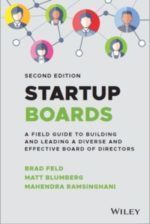
New book from Brad Feld: The Startup Community Way
My long-time friend and former Board member Brad Feld has become a prolific writer on the startup world over the years and is the person (other than me) most responsible for me getting into that scene as well. Startup CEO is part of his Startup Revolution series, which followed me writing an essay for Do More Faster, and then writing a series of sidebars call “The Entrepreneur’s Perspective” in Venture Deals.
All Brad’s books are listed here. If you’re in the startup universe, I’d encourage you to read all of them. I’m excited to dive into his newest book, The Startup Community Way, which comes out this week from our same publisher, John Wiley & Sons. I’ve gotten part of the way through an early copy, and I love it already.
The approach Brad and his co-author Ian Hathaway take is to evolve their Boulder Thesis from the original Startup Communities book. They dive into the topic and examine it from the perspective of a complex system, which of course anything as fragmented as an ecosystem of public, private, and academic organizations is.
The book — and the whole topic, quite frankly — remind me of a great management book I read several years ago by General Stanley McChrystal called Team of Teams. Organizations have gotten more complex and have had to adapt their structures, and the most successful ones are the ones that have shifted from hierarchical structures to node-based structures, or teams of teams, where individual, agile teams operate with loose points of connection to other teams that focus on dependencies and outcomes.
In the same way, startup communities and the broader ecosystems that touch them have changed and adapted, and the successful ones have learned how to stay loosely connected to other startup communities, prioritize collaboration, and remain focused on inclusion and entrepreneurial leadership.
Why Publishing Will Never Be the Same, Part I
Why Publishing Will Never Be the Same, Part I
As you may know, we published a book earlier this year at Return Path called Sign Me Up! Sales are going quite well, in case you’re wondering, and we also launched the book’s official web site, where you can subscribe to our “email best practices” newsletter.
The process of publishing the book was fascinating and convinced me that publishing will never be the same. Even in two parts, this will be a long post, so apologies in advance. Front to back, the process went something like this:
– We wrote the content and selected and prepared the graphics
– We hired iUniverse to publish the book for a rough total cost of $1,500
– iUniverse provided copy editing, layout, and cover design services
– Within 8 weeks, iUniverse put the book on Amazon.com and BN.com for us (in addition to their site) and properly indexed it for search, and poof — we were in business
– Any time someone places an order on any of those three sites, iUniverse prints a copy on demand, binds it, and ships it off. No fuss, no muss, no inventory, but a slightly higher unit cost than you’d get from a traditional publisher who mass prints. We receive approximately 20% of the revenue from the book sale, and iUniverse receives 80%. I’m not sure what cut they give Amazon, but it’s hard to imagine it’s more than 10-20% of the gross
Other than the writing part (not to be minimized), how easy is that? So of course, that made me think about the poor, poor publishing industry. It seems to me that, like many other industries, technology is revolutionizing publishing. Here’s how:
– Publishers handle printing and inventory. iUniverse and its competitors can do it for you in a significantly more economic way. Print on Demand will soon be de rigeur.
– Publishers handle marketing and distribution. iUniverse gets you on Amazon.com and BN.com for free. Amazon.com and BN.com now represent something like 12% of all book sales (cobbled together stats from iMedia Connection saying the annual online book sale run rate is now about $3 billion and the Association of American Publishers saying that the total size of the industry is $24 billion). Google and Overture take credit cards and about 5 minutes to drive people to buy your book online. Buzz and viral and email marketing techniques are easy and cheap.
– Publishers pay you. Ok, this is compelling, but they only pay you (especially advances) if you’re really, really good, or a recognized author or expert. iUniverse pays as well, just in a pay-for-performance model. Bonus points for setting yourself up as an affiliate on Amazon and BN to make even more money on the sale. iUniverse actually pays a higher royalty (20% vs. 7.5-15% in the traditional model), so you’re probably always a fixed amount “behind” in the self-publish model, but you don’t have an agent to pay.
Unless you are dying to be accepted into literary or academic circles that require Someone & Sons to annoint you…why bother with a traditional publisher? As long as you have the up-front money and the belief that you’ll sell enough books to cover your expenses and then some, do it yourself.
In Part II, I will talk about how iUniverse pitches a “traditional publishing model” and why it only reinforces the point that the traditional model doesn’t make a lot of sense any more in many cases.
How to Get Laid Off
How to Get Laid Off – an Employee’s Perspective
One of my colleagues at Return Path saw my post about How to Quit Your Job about 5 years ago and was inspired to share this story with me. Don’t read anything into this post, team! There is no other meaning behind my posting it at this time, or any time, other than thinking it’s a very good way of approaching a very difficult situation, especially coming from an employee.
In 2009 I was working at a software security start up in the Silicon Valley. Times were exceedingly tough, there were several rounds of layoffs that year, and in May I was finally on the list. I was informed on a Tuesday that my last day was that Friday. It was a horrible time to be without a job (and benefits), there was almost no hiring at all that year, one of the worst economic down turns on record. While it was a hard message, I knew that it was not personal, I was just caught up on a bad math problem.
After calling home to share the bad news, I went back to my desk and kept working. I had never been laid off and was not sure what to do, but I was pretty sure I would have plenty of free time in the short term, so I set about figuring out how to wrap things up there. Later that day the founder of the company came by, asked why I had not gone home, and I replied that I would be fine with working till the end of the week if he was okay with it. He thanked me.
Later that week, in a meeting where we reviewed and prioritized the projects I was working on, we discussed who would take on the top three that were quite important to the future of the company. A few names were mentioned of who could keep them alive, but they were people who I knew would not focus on them at all. So I suggested they have me continue to work on them, that got an funny look but when he thought about it , it made sense, they could 1099 me one day a week. The next day we set it up. I made more money than I could of on unemployment, but even better I kept my laptop and work email, so I looked employed which paid off later.
That one day later became two days and then three, however, I eventually found other full time work in 2010. Layoffs are hard, but it is not a time to burn bridges. In fact one of the execs of that company is a reference and has offered me other opportunities for employment.
Why I joined the DMA Board, and what you can expect of me in that role
Why I joined the DMA Board, and what you can expect of me in that role
I don’t normally think of myself as a rebel. But one outcome of the DMA’s recent proxy fight with Board member Gerry Pike is that I’ve been appointed to the DMA’s Board and its Executive Committee and have been labeled “part of the reform movement” in the trade press. While I wasn’t actively leading the charge on DMA reform with Gerry, I am very enthusiastic about taking up my new role.
I gave Gerry my proxy and support for a number of reasons, and those reasons will form the basis of my agenda as a DMA Board member. As a DMA member, and one who used to be fairly active, I have grown increasingly frustrated with the DMA over the past few years.
1. The DMA could be stronger in fighting for consumers’ interests. Why? Because what’s good for consumers is great for direct marketers. Marketing is not what it used to be, the lines between good and bad actors have been blurred, and the consumer is now in charge. The DMA needs to more emphatically embrace that and lead change among its membership to do the same. The DMA’s ethics operation seems to work well, but the DMA can’t and shouldn’t become a police state and catch every violation of every member company. Its best practices and guidelines take too long to produce and usually end up too watered down to be meaningful in a world where the organization is promoting industry self-regulation. By aggressively fighting for consumers, the DMA can show the world that a real direct marketer is an honest marketer that consumers want to hear from and buy from.
2. Despite a number of very good ideas, the DMA’s execution around interactive marketing has been lacking. The DMA needs to accept that interactive marketing IS direct marketing – not a subset, not a weird little niche. It’s the heart and soul of the direct marketing industry. It’s our future. The acquisition of the EEC has been one bright spot, but the DMA could do much more to make the EEC more impactful, grow its membership, and replicate it to extend the DMA’s reach into other areas of interactive marketing, from search to display advertising to lead generation. The DMA’s staff still has extremely limited experience in interactive marketing, they haven’t had a thought leader around interactive on staff for several years, and their own interactive marketing efforts are far from best practice. Finally, the DMA’s government affairs group, perhaps its greatest strength, still seems disproportionately focused on direct mail issues. The DMA should maintain its staunch support of traditional direct marketers while investing in the future, making interactive marketing an equal or larger priority than traditional direct marketing. We have to invest in the future.
3. Finally, I think the DMA suffers from a lack of transparency that doesn’t serve it well in the hyper-connected world we live in here in 2009 – that’s a nice way of saying the organization has a big PR problem. The organization does a lot of great work that never gets adequately publicized. This whole proxy fight episode is another example, both in the weak response from the DMA and also in a lot of the complaints Gerry lodged against the organization, many of which the organization says are untrue or misleading. Senior DMA execs or Board members should be blogging. They should be active thought leaders in the community. They should be much more engaged with their members to both understand member needs and requirements and more aggressively promote their agenda.
In short, I will be an independent voice who advocates for progress and change in the areas that I consider to be most important, and I will be transparent and open about expressing my views. I’ve already been clear with the existing DMA Board and management that I do have this agenda, and that I hope the organization will embrace it. If they do, even if only in part, I think it will be to the DMA’s benefit as well as the benefit of its members. If they reject it wholesale, my interest in long-term involvement will be fairly low.
That’s the story. As I said up front, I am taking up this new role with enthusiasm and with the belief that the DMA is open to change and progress. We’ll see how it goes, and I will blog about it as often as I can.
Do you have thoughts on the future of the DMA? I’d love to hear from you. You can leave a comment below or email me directly at matt at returnpath dot net.
Running a Productive Offsite
Running a Productive Offsite
A couple OnlyOnce readers asked me to do a post on how I run senior team offsites. It’s a great part of our management meeting routine at Return Path, and one that Patrick Lencioni talks about extensively in Death by Meeting (review, book) – a book worth reading if you care about this topic.
My senior team has four offsites per year. I love them. They are, along with my Board meetings, my favorite times of the year at work. Here’s my formula for these meetings:
– WHY: There are a few purposes to our offsites. One for us is that our senior team is geographically distributed across 4 geographies at the executive level and 6 or 7 at the broader management team level. So for us, these are the only times of the year that we are actually in the same place. But even if we were all in one place, we’d still do them. The main purpose of the offsite is to pull up from the day-to-day and tackle strategic issues or things that just require more uninterrupted time. The secondary purpose is to continue to build and develop the team, both personal relationships and team dynamics. It’s critically important to build and sustain deep relationships across the Executive Team. We need this time in order to be a coordinated, cohesive, high trust, aligned leadership team for the company. As the company has expanded (particularly to diverse geographies), our senior team development has become increasingly critical
– WHO: Every offsite includes what we call our Executive Committee, which is for the most part, my direct reports, though that group also includes a couple C/SVP titled people who don’t report directly to me but who run significant parts of the company (7-8 people total). Two of the four offsites we also invite the broader leadership team, which is for the most part all of the people reporting into the Executive Committee (another 20 people). That part is new as we’ve gotten bigger. In the earlier days, it was just my staff, and maybe one or two other people as needed for specific topics
– WHERE: Offsites aren’t always offsite for us. We vary location to make geography work for people. And we try to contain costs across all of them. So every year, probably 2 of them are actually in one of our offices or at an inexpensive nearby hotel. Then the other 2 are at somewhat nicer places, usually one at a conference-oriented hotel and then one at a more fun resort kind of place. Even when we are in one of our offices, we really treat it like an offsite – no other meetings, etc., and we make sure we are out together at dinner every night
– WHEN: 4x/year at roughly equal intervals. We used to do them right before Board meetings as partial prep for those meetings, but that got too crowded. Now we basically do them between Board meetings. The only timing that’s critical is the end of year session which is all about budgeting and planning for the following year. Our general formula when it’s the smaller group is two days and at least one, maybe two dinners. When it’s the larger group, it’s three days and at least two dinners. For longer meetings, we try to do at least a few hours of fun activity built into the schedule so it’s not all work.
– WHAT: Our offsites are super rigorous. We put our heads together to wrestle with (sometimes solve) tough business problems – from how we’re running the company, to what’s happening with our culture, to strategic problems with our products, services and operations. The agenda for these offsites varies widely, but the format is usually pretty consistent. I usually open every offsite with some remarks and overall themes – a mini-state-of-the-union. Then we do some kind of “check-in” exercise either about what people want to get out of the offsite, or something more fun like an envisioning exercise, something on a whiteboard or with post-its, etc. We always try to spend half a day on team and individual development. Each of us reads out our key development plan items from our most recent individual 360, does a self-assessment, then the rest of the team piles on with other data and opinions, so we keep each other honest and keep the feedback flowing. Then we have a team development plan check-in that’s the same, but about how the team is interacting. We always have one or two major topics to discuss coming in, and each of those has an owner and materials or a discussion paper sent out a few days ahead of time. Then we usually have a laundry list of smaller items ranging from dumb/tactical to brain-teasing that we work in between topics or over meals (every meal has an agenda!). There’s also time at breaks for sub-group meetings and ad hoc conversations. We do try to come up for air, but the together time is so valuable that we squeeze every drop out of it. Some of our best “meetings” over the years have happened side-by-side on elliptical trainers in the hotel gym at 6 a.m. We usually have a closing check-out, next steps recap type of exercise as well.
– HOW: Lots of our time together is just the team, but we usually have our long-time executive coach Marc Maltz from Triad Consulting facilitate the development plan section of the meeting.
I’m sure I missed some key things here. Team, feel free to comment and add. Others with other experiences, please do the same!
Email Intelligence and the new Return Path
Welcome to the new Return Path.
For a tech company to grow and thrive in the 21st century it must be in a state of constant adaptation. We have been the global market leaders in email deliverability since my co-founder George Bilbrey coined that term back in 2002. In fact, back in 2008 we announced a major corporate reorganization, divesting ourselves of some legacy businesses in order to focus on deliverability as our core business.
Since then Return Path has grown tremendously thanks to that focus, but we have grown to the point where it’s time for us to redefine ourselves once again. Now we’re launching a new chapter in the company’s history to meet evolving needs in our marketplace. We’re establishing ourselves as the global market leaders in email intelligence. Read on and I’ll explain what that means and why it’s important.
What Return Path Released Today
We launched three new products today to improve inbox placement rate (the new Inbox Monitor, now including subscriber-level data), identify phishing attacks (Email Brand Monitor), and make it easier to understand subscriber engagement and benchmark your program against your competition (Inbox Insight, a groundbreaking new solution). We’ve also released an important research study conducted by David Daniels at The Relevancy Group.
The report’s findings parallel what we’ve been hearing more and more recently. Email marketers are struggling with two core problems that complicate their decision making: They have access to so much data, they can’t possibly analyze it fast enough or thoroughly enough to benefit from it; and too often they don’t have access to the data they really need.
Meanwhile they face new challenges in addition to the ones email marketers have been battling for years. It’s still hard to get to the inbox, and even to monitor how much mail isn’t getting there. It’s still hard to protect brands and their customers from phishing and spoofing, and even to see when mail streams are under attack. And it’s still hard to see engagement measurements, even as they become more important to marketing performance.
Email Intelligence is the Answer
Our solution to these problems is Email Intelligence. Email intelligence is the combination of data from across the email ecosystem, analytics that make it accessible and manageable, and insight that makes it actionable. Marketers need all of these to understand their email performance beyond deliverability. They need it to benchmark themselves against competitors, to gain a complete understanding of their subscribers’ experience, and to accurately track and report the full impact of their email programs. In fact, we have redefined our company’s mission statement to align with our shift from being the global leader in Email Deliverability to being the global leader in Email Intelligence:
We analyze email data and build solutions that generate insights for senders, mailbox providers, and users to ensure that inboxes contain only messages that users want
The products we are launching today, in combination with the rest of our Email Intelligence Solution for Marketers that’s been serving clients for a decade, will help meet these market needs, but we continue to look ahead to find solutions to bigger problems. I see our evolution into an Email Intelligence company as an opportunity to change the entire ecosystem, to make email better, more welcome, more effective, and more secure.
David’s researchoffers a unique view of marketers’ place in the ecosystem, where they want to get to, how much progress they’ve made, and how big a lead the top competitors have opened up against the rest. (It can also give you a sense of where your efforts stack up vs. the rest of the industry.) There are definitely some surprises, but for me the biggest takeaway was no surprise at all: The factors that separate the leaders are essentially the core components of what we define as Email Intelligence.