
Book Short: A Marketing-Led Turnaround
Book Short: A Marketing-Led Turnaround
Generally, I love books by practitioners even more than those by academics. That’s why Steve McKee’s first (I assume) book, When Growth Stalls: How it Happens, Why You’re Stuck, and What to do About It (book, Kindle edition) appealed to me right out of the gate. The author is CEO of a mid-size agency and a prior Inc. 500 winner who has experienced the problem firsthand – then went out, researched it, and wrote about it. As a two-time Inc. 500 winner ourselves, Return Path has also struggled with keeping the growth flames burning over the years, so I was eager to dig into the research. The title also grabbed my attention, as there are few if any business books really geared at growth stage companies.
I’d say the book was “solid” in the end, not spectacular. Overall, it felt very consistent with a lot of other business books I’ve read over the years, from Trout & Reis to Lencioni to Collins, which is good. The first half of the book, describing the reasons why growth stalls, was quite good and very multi-faceted. His labeling description of “market tectonics” is vivid and well done. He gets into management and leadership failings around both focus and consensus, all true. Perhaps his most poignant cause of stalls in growth is what he calls “loss of nerve,” which is a brilliant way of capturing the tendence of weak leadership when times get tough to play defense instead of offense.
The problem with the book in the end is that the second section, which is the “how to reverse the stall” section, is way too focused on marketing. That can be the problem with a specialty practitioner writing a general business book. What’s in the books makes a lot of sense about going back to ground zero on positioning, market and target customer definition and understanding, and the like. But reversing the stall of company can and usually must involve lots of the other same facets that are documented in the first half of the book — and some other things as well, like aggressive change management and internal communication, systems and process changes, financial work, etc.
At any rate, if you are in a company where growth is stalling, it’s certainly a good read and worth your time, as what’s in it is good (it’s what’s missing that tempers my enthusiasm for it). In this same category, I’d also strongly recommend Confidence: How Winning Streaks and Losing Streaks Begin and End, by Rosabeth Moss Kanter, as well.
Book Short: Way, Way Beyond Books
Book Short: Way, Way Beyond Books
The Everything Store: Jeff Bezos and the Age of Amazon, by Brad Stone, was a great read. Amazon is a fascinating, and phenomenally successful company, and Jeff is a legendary technology leader. The Everything Store is a company and personal biography and totally delivers.
Forget about the fact that Amazon is now almost $100B in revenues and still growing like mad. I find it even more amazing that a single company could be the largest ecommerce site on the planet while successfully pioneering both cloud computing services and e-readers. The stories of all these things are in the book.
As a CEO, I enjoyed reading more of the vignettes behind the things that Amazon is reputationally known for in the tech world – doors as desks, their unique meeting formats, the toughness of the culture, the extensive risk taking of growth over profits, and what works and does not work about Bezos’ authoritative and domineering style. And it’s always great to be reminded that even the biggest and best companies had to cheat death 10 times over before “arriving.”
This is good fun and learning for anyone in the business world. It reminded me most of Walter Isaacson’s biography of Steve Jobs ,which I wrote about here, although it’s more of a company history and less of a biography than the Jobs book.
The Best Place to Work, Part 1: Surround yourself with the best and brightest
First in my series of posts around creating the best place to work is to Surround yourself with the best and brightest. This one is simple. Build the best team you can possibly build…as you need it.
As a founder, you may be the best person at doing everything in your company, especially if you are a technical founder. But as my long-time Board member at Return Path Greg Sands always says, when the organism grows, cells start to specialize. Eventually, you need a liver and a brain. Just like companies need a head of sales and a CFO (not to imply that Anita likes the occasional cocktail or that Jack likes math – turns out both like both).
How does this come into play as a CEO?
-Don’t be afraid to hire people better than you at their specialty – older, wiser, more experienced, more expensive
– Check references carefully – don’t get suckered in by resume or rolodex – some successful big company people don’t actually know how to do work or build a business, so you have to dig and find back-channel references
– Don’t overhire before you’re ready, but especially as a start-up, better to hire 3 months before you need the position, not 6 months too late
-Remember that you are the CEO. Even if you hire very experienced people in specific roles, you have the best global view of everything going on in the company. And you need to pay attention to people on your team and actively manage them, even experts who are older or wiser than you are
Surrounding yourself with the best and brightest can be daunting and even threatening to some CEOs. But you have to do it to grow your business. And you have to keep doing it as you keep growing your business (and your staff has to do the same!).
Book Short: Like a Prequel to My Book
Book Short: Like a Prequel to My Book
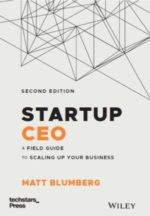
How to Start a Business, by Jason Nazar, CEO of our client Docstoc, is a great and quick (and free) eBook that feels a lot like a prequel to my book Startup CEO: A Field Guide to Scaling Up Your Business (original outline here). My book is about scaling a business once you’ve started it. Jason’s book is a really practical guide to starting it in the first place.
The thing that’s particularly good about this book is that it’s as much a resource guide as it is a book. At the end of each of its 24 chapters (and within them as well), Jason adds a series of external links to other resources, from videos to checklists to templates. The book answers a lot of really practical questions that are easy for product-focused entrepreneurs to gloss over or ignore, from corporate structures to insurance, from trademark registration to pitching VCs, from payroll to tax planning.
It’s great to see so much more being written for entrepreneurs these days. Ash Maurya’s Running Lean: Iterate from Plan A to a Plan That Works (which I blogged about last week) is another related book that focuses on how to bring a new product to market. But Jason’s eBook is a must read for anyone in TechStars or any accelerator program, or anyone contemplating starting a business.
Book Short: Plain Talk
Book Short: Plain Talk
An HR rock star I met with recently told me that “You can say anything you want to your people, as long as it’s true,” which of course is great advice. Plain Talk: Lessons from a Business Maverick (book, kindle), by Ken Iverson, the long-time CEO of Nucor, pretty much embodies that. If you’re not familiar with Nucor, it’s a steel company – right, steel – and the most successful one of the last 50-75 years, at that. You may think an industrial company like this offers no lessons for you. If so, you are wrong.
The reason Nucor has been so successful, if you believe their long time leader, is that they run the people side of their business differently than most companies like them. Reading this book from the perspective of a knowledge worker business CEO was particularly interesting, since I had to transform my frame of reference a bit (and do a little mental time travel as well) in order to understand just how revolutionary Nucor’s practices were at the time.
But then I realized – they’re still revolutionary today. How many companies – even the most progressive ones – don’t have performance reviews because they don’t need them in order to create a high performing environment? Companies that spend a good percentage of their time and energies thinking about how to get their employees to do their best work, as opposed to focusing only on the goals of the business, do better than those who don’t. It doesn’t matter what industry you’re in. As Patrick Lencioni would say, you can outbehave the competition.
Plain Talk is a really short book, and a good, authentic read if you’re a leader who cares about your people and wants to learn a few nuggets here and there from one of the 20th century masters of that discipline. Anyone that can link a high degree of delegation to authority has a story worth telling.
Book Short: Which Runs Faster, You or Your Company?
Book Short: Which Runs Faster, You or Your Company?
Leading at the Speed of Growth, by Katherine Catlin at the Kauffman Center for Entrepreneurial Leadership is a must read for any entrepreneur or CEO of a growth company. It’s one of the best books I’ve ever read targeted to that audience – its content is great, its format is a page-turner, and it’s concise and to the point.
The authors take you through three stages of a growth company’s lifestyle (Initial Growth, Rapid Growth, and Continuous Growth) and describe the “how to’s” of the transition into each stage: how you know it’s coming, how to behave in the new stage, how to leave the old stage behind.
I didn’t realize it when I started reading the book, but Brad had one of the quotes on the back cover that says it all: “There are business books about starting a company, but they tend to deal with the mechanics of business plans and financing. Then there are books about ‘how to be the CEO of a Fortune 500 company.’ This is the first book I’ve seen that details the role of the CEO of a small but growing company.” Thanks to my colleague George Bilbrey for pointing this one out to me.
UPDATE: Brad corrects me and says that I should mention Jana Matthews, who co-wrote the book with Katherine Catlin and is actually the Kauffman Center person of the duo.
Book Short: Unsung Heroes
Book Short: Unsung Heroes
If you like “entrepreneurship by analogy” books, you’ll like The Innovators: The Engineering Pioneers Who Made America Modern, by David Billington. I have to admit some bias here — Professor Billington was my favorite teacher and senior thesis advisor at Princeton (I almost majored in civil engineering because of him), and this book is one of a number he’s written that are outgrowths of his most popular courses at Princeton. And while there’s no substitute for the length or energy of his lectures, the book works.
The book is basically a person-focused engineering history of America from 1776-1883. Billington talks about four classes of engineering product: public structures (mostly bridges), machines that produced power, networks like the railroads and telegraphs, and processes like steel manufacturing.
His approach is to acknowledge that the Americans innovators couldn’t do much without the right context: learnings from their counterparts in Britain, a supportive government here at home, and abundant raw materials and capital. But with that backdrop in place, Billington tells the tale of a number of the inventions that built our modern society with a focus on the engineers who got things right. While some of them are familiar names (Morse, Edison), many are not (Thomas Telford, J. Edgar Thomson, Joseph Henry).
Sound familiar? It feels at many point in the book that you could insert some different names and dates and be reading a history of the Internet or information age. And as with the Industrial Revolution, while many of the innovators in our world today are known (Bezos, Yang, Brin/Page), there are probably an equal number who are unsung heroes — either software engineers or even buisness model pioneers who haven’t sought or won’t end up in the spotlight even though their contributions to society or to their companies are giant. I know there are a number of unsung heroes in our own engineering department at Return Path — people who aren’t market facing and who never get quoted in press releases, but who really make a difference in how the company works and how competitive we are. This book celebrates those people as much as it does the entrepreneurs you’ve heard of.
Warning, there are lots of pages which are full of mathematical formulas, which may or may not be interesting to you, but the book still holds together 100% if you skip over them.
Book Short: Crazy Eights
Book Short: Crazy Eights
In honor of Return Path being in the midst of its eighth year, I recently read a pair of books with 8 in the title (ok, I would have read them anyway, but that made for a convenient criterion when selecting out of my very large “to read” pile).
Ram Charan’s latest, Know-How: The 8 Skills That Separate People People Who Perform From Those Who Don’t, was pretty good and classic Charan. Quick, easy to skim and still get the main points. The book lost a little credibility with me when Charan lionized Verizon (perhaps he uses a different carrier himself) and Bob Nardelli (the book was published before Nardelli’s high profile dismissal), but makes good points nonetheless. Some of the 8 Skills he talks about are what you’d expect on the soft side of leadership — building the team, understanding the social system, judging people — but his best examples were particularly actionable around positioning, goal setting, and setting priorities. The book reminded me much more of Execution and much less of Confronting Reality (which is a good thing).
For years I’ve felt like the last person around to still not have read The 7 Habits of Highly Effective People, so I thought I’d skip straight to the punchline and read Stephen Covey’s newer book, The 8th Habit: From Effectiveness to Greatness. Fortunately, as I’d hoped, the new book summarizes the prior book several times over, so if you haven’t read the first, you could certainly just start with this one. The book also comes with a DVD of 16 short films, some of which are great — both inspirational and poignant. Unlike most business books, the 8th Habit is NOT skimmable. It almost has too much material in it and could probably be read multiple times or at least in smaller pieces. The actual 8th habit Covey talks about is what he calls Find Your Voice and Help Others Find Their Voices and is a great encapsulation of what leading a knowledge worker business is all about. But the book is much deeper and richer than that in its many models and frameworks and examples/tie-ins to business and goes beyond the “touchy feely” into hard-nosed topics around execution and strategy.
Now I’m looking for the DVD of the first season of Eight is Enough!
Book (Not So) Short: Raise Your Hand If You’re Sure
Book (Not So) Short: Raise Your Hand If You’re Sure
I couldn’t get the catchy jingle from the 80’s commercial for Sure deodorant (you remember, the one with the Statue of Liberty at the end of it – thanks, YouTube) out of my head while I was reading the relatively new book, Confidence: How Winning Streaks and Losing Streaks Begin and End. Written by HBS professor Rosabeth Moss Kantor, Confidence is one of the few business books I’ve read that’s both long and worth reading in full.
The book has scores of examples of both winning and losing streaks, from sports, business, politics, and other walks of life, and it does a great job of breaking down the core elements that go into creating a winning streak or turnaround (Accountability, Collaboration, Innovation). Kantor also puts a very fine point on the “doom loop” of losing streaks and just how hard it is to turn them around. The book also has a good crisp definition of why winning streaks end — arrogange, anyone? — and has consistent, but not preachy recipes for avoiding pitfalls and driving success. All in all, very inspirational, even if many of the roots of success lie in well-documented leadership qualities like those expressed in Jim Collins’ Built to Last and Good to Great. The book is good enough that Kantor can even be forgiven for lauding Verizon, probably the most consistently awful customer service company I’ve ever dealt with.
But even more of the roots of success and disappointment around streaks are psychological, and these examples really rang true for me as I reflected back on our acquisition of the troubled NetCreations in 2004. That company was in the midst of a serious slump, a losing streak dating back to 2000, at the peak of the original Internet boom. Year over year, the company had lost revenues, profits, customers, and key personnel. Its parent company saw poor results and set it into the doom loop of starving it for resources and alternating between ignoring it and micromanaging it, and when we acquired the business, we found great assets and some fantastic people (many of whom I’m proud to say are still with us today), but a dispirited, blame-oriented, passive culture that was poised to continue wallowing in decline.
I can hardly claim that we’ve turned the business around in full, or that I personally made happen whatever turnaround there has been, but I do think we did a few things right as far as Kantor and Confidence would see it. Her formula for a turnaround (Espouse the new message, Exemplify it with leadership actions, Establish programs to systematically drive it home throughout the organization) is right in line with our philosophy here at Return Path.
First, we accelerated the separation and autonomy of a fledgeling NetCreations spin-off unit, now our Authentic Response market research group, and let a culture of collaboration and innovation flourish under an exceptionally talented leader, Jeff Mattes.
But that was the easy part (for me anyway), because that part of the business was actually working well, and we just let it do its thing, with more support from HQ. The turnaround of the core list rental and lead generation business of NetCreations, the original Postmaster Direct, was much tougher and is still a work in progress. In the last six months, we’ve finally turned the corner, but it hasn’t been easy. Even though we knew lots of what had to be done early on, actually doing it is much harder than b-school platitudes or even the best-written books make it seem.
The one thing that Kantor probably gives short shrift to, although she does mention it in passing a couple times, is that frequently turnarounds require massive major amounts of purging of personnel (not just management) to take hold. As one of my former colleagues from Mercer Management Consulting used to say, “sometimes the only way to effect Change Management is to change management.” Sometimes even very talented people are just bogged down with baggage — the “ghost of quarters past” — and nothing you do or say can break that psychological barrier.
Boy, have we learned that lesson here at Return Path the hard way. I’m extremely grateful to our team at Return Path, from the old RP people who’ve seen it all happen, to the old NetCreations people who are thriving in the new environment, to the new blood we’ve brought in to help effect the turnaround, for playing such important roles in our own Confidence-building exercises here. And I’m super Confident that 2007 will be the year that we officially turn the old NetCreations/Postmaster losing streak into a big, multi-year winning streak.
Anyway, I realize this may redefine the “short” in book short, but Confidence is without question a good general management and leadership read.
Book Short: Loving the Strengths Movement More Than the Book
Book Short: Loving the Strengths Movement More Than the Book
I’m a big believer in the so-called Strengths Movement — that we would all be better served by playing to our strengths than agonizing over fixing our weaknesses. I think it’s true both in professional and personal settings.
The books written by Marcus Buckingham that come out of Gallup’s extensive research into corporate America, First, Break All the Rules (about management) and Now, Discover Your Strengths (self-management) are both quite good. Another book written by someone else off the same research corpus, 12: The Elements of Great Managing is ok, but not as good, as I wrote about here.
Buckingham’s newest, Go Put Your Strengths to Work: 6 Powerful Steps to Achieve Outstanding Performance, is fine and has some good points but is way too long, a little hokey, and has a lot of online companion material that is far more interesting sounding than it is actually useful.
The book does build nicely on Now, Discover Your Strengths by giving you inspiration and a framework for taking those signature themes from the prior book and translating them into action — stuff you actually do every day that plays to your strengths and draws out your weaknesses. And that’s helpful. Some of his suggestions for what you do with that information are ok but a bit common sense only and way too drawn out (“here’s how to talk to your boss…”).
To be fair, I am going to do some of the work that Buckingham recommended doing — so I guess that says something about the power of the book, or at least the movement underlying it. But not the best read in the world.
Book Short: Sloppy Sequel
Book Short: Sloppy Sequel
SuperFreakonomics, by Steven Levitt and Stephen Dubner, wasn’t a bad book, but it wasn’t nearly as good as the original Freakonomics, either. I always find the results of “naturally controlled experiments” and taking a data-driven view of the world to be very refreshing. And as much as I like the social scientist versions of these kinds of books like Malcolm Gladwell’s The Tipping Point

That’s where SuperFreakonomics fell down a bit for me. Paul Krugman has described the book in a couple different places as “snarky and contrarian.” I typically enjoy books that carry those descriptors, but this one seemed a bit over the top for economists — like a series of theories looking for data more than raw data adding up to theories.Nowhere is this more true than the chapter on climate change. It’s a shame that that chapter seems to be swallowing up all the public discussion about the book, because there are some good points in that chapter, and the rest of the book is better than that particular chapter, but such is life.
As with all things related to the environment, I turned to my friend Andrew Winston’s blog, where he has a good post about how the authors kind of miss the point about climate change…and he also has a series of links to other blog posts debunking this one chapter. If you’re into the topic, or if you read the book, follow the chain here for good reading. My conclusion about this chapter, being at least somewhat informed about the climate change debate, is that the book seems to have sloppy writing and editing at best, possibly deliberately misleading at worst. (Incidentally, the reaction in the blogosphere seems highly emotional, other than Andrew’s, which probably doesn’t serve the reactors well.)
But I’ll assume the best of intentions. Some of the points made aren’t bad – there is no debate about the problem or the need to solve it, the authors express legitimate concern that current solutions, especially those requiring behavioral change, will be too little too late, and most interestingly, they show an interest in alternative approaches like geo-engineering. I hadn’t been familiar with that topic at all, but I’m now much more interested in it, not because it’s a “silver bullet” approach to dealing with climate change, but because it’s a different approach, and complex problems like climate change deserve to have a wide range of people working on multiple types of solutions. I met Nathan Myhrvold once (I almost threw up on him during a job interview, which is another story for another day), and it makes me very happy that his brilliance is being applied to this problem as a general principle.
As I said, though, beyond this one chapter, the book is good-not-great. But it certainly is chock full of cocktail party nuggets!
![Reblog this post [with Zemanta]](https://i0.wp.com/img.zemanta.com/reblog_e.png?w=640)