
Book Short: Be Less Clever
Book Short: Be Less Clever
In Search of the Obvious: The Antidote for Today’s Marketing Mess, by Jack Trout, is probably deserving of a read by most CEOs. Trout at this point is a bit old school and curmudgeonly, the book has some sections which are a bit repetitive of other books he and his former partner Al Reis have written over the years, he does go off on some irrelevant rants, and his examples are a bit too focused on TV advertising, BUT his premise is great, and it’s universally applicable. So much so that my colleagues Leah, Anita, and I had “book club” about it one night last week and had a very productive debate about our own positioning and marketing statements and how obvious they were (they need work!).
The premise in short is that, in advertising:
Logical, direct, obvious = relevant, and
Entertaining, emotional = irrelevant
And he’s got data to back it up, including a great case study from TiVo on which ads are skipped and not skipped – the ones that aren’t skipped are from companies like Bowflex, Hooters, and the Dominican Republic, where the presentation of the ad is very direct, explanatory of the product, and clear. His reasons why advertising have drifted away from the obvious are probably right, ranging from the egos of marketing people, to CEOs being to disconnected from marketing, to the rise in importance of advertising awards, and his solution, of course is to refocus on your core positioning/competitive positioning.
It is true that when the only tool in your box is a hammer, everything starts to look a bit like a nail, but Trout is probably right in this case. He does remind us in this book that “Marketing is not a battle of products. It is a battle of perceptions”– words to live by.
And some of his examples of great obvious advertising statements, either real or ones he thinks should have been used, are very revealing:
- Kerry should have turned charges that he was a flip-flopper in 2004 around on Bush with the simple line that Bush was “strong but wrong”
- New Zealand: “the world’s most beautiful two islands”
- The brilliance of the VW Beetle in a big-car era and “thinking small”
- Johnny Cochrane’s winning (over)simplification of the OJ case — “If the glove doesn’t fit, you must acquit”
- BMW is still, 30 years later, The Ultimate Driving Machine
- “Every day, the Kremlin gets 12 copies of the Wall Street Journal. Maybe they know something you don’t know.”
If you are looking for a good marketing book to read as a refresher this year, this one could be it. And if you’re not a very market-focused CEO, this kind of thinking is a must.
And for the record, the library of books by Trout and/or Reis (sometimes including Reis’ daughter Laura as well) that I’ve read, all of which are quite good, is:
- Positioning: The Battle for Your Mind – the original – a brilliant, short, classic
- The New Positioning (link, post) – good refresher on the original, gets into repositioning
- Marketing Warfare –
- The Fall of Advertising and the Rise of PR – excellent but pre-social media
- The 22 Immutable Laws of Branding –
- The 22 Immutable Laws of Marketing: Violate Them at Your Own Risk! –
- Bottom-up Marketing –
- Differentiate or Die: Survival in Our Era of Killer Competition –
- In Search of the Obvious: The Antidote for Today’s Marketing Mess – the current book
Book Short: Which Runs Faster, You or Your Company?
Book Short: Which Runs Faster, You or Your Company?
Leading at the Speed of Growth, by Katherine Catlin at the Kauffman Center for Entrepreneurial Leadership is a must read for any entrepreneur or CEO of a growth company. It’s one of the best books I’ve ever read targeted to that audience – its content is great, its format is a page-turner, and it’s concise and to the point.
The authors take you through three stages of a growth company’s lifestyle (Initial Growth, Rapid Growth, and Continuous Growth) and describe the “how to’s” of the transition into each stage: how you know it’s coming, how to behave in the new stage, how to leave the old stage behind.
I didn’t realize it when I started reading the book, but Brad had one of the quotes on the back cover that says it all: “There are business books about starting a company, but they tend to deal with the mechanics of business plans and financing. Then there are books about ‘how to be the CEO of a Fortune 500 company.’ This is the first book I’ve seen that details the role of the CEO of a small but growing company.” Thanks to my colleague George Bilbrey for pointing this one out to me.
UPDATE: Brad corrects me and says that I should mention Jana Matthews, who co-wrote the book with Katherine Catlin and is actually the Kauffman Center person of the duo.
Book Short – Another Must-Read by Lencioni
Book Short – Another Must-Read by Lencioni
The Ideal Team Player: How to Recognize and Cultivate The Three Essential Virtues (hardcover,kindle is Patrick Lencioni’s latest and greatest. It’s not my favorite of his, which is still The Advantage (post,buy ), but it’s pretty good and well worth a read. It builds on his model for accountability in The Five Dysfunctions of a Team (post,buy)and brings it back to “how can you spot or develop and a good team player?”
The central thesis of the book is that great team players have three attributes – hungry, humble, and people-smart. While I can’t disagree with those three things, as with all consultants’ frameworks, I sound two cautionary notes: (1) they aren’t the absolute truth, just a truth, and (2) different organizations and different cultures sometimes thrive with different recipes. That said, certainly for my company, this framework rings true, if not the only truth.
Some great nuggets from the book:
-The basketball coach who says he loves kids who want to come to practice and work as hard as they can at practice to avoid losing
-The concept of Addition by Addition and Addition by Subtraction in the same book – both are real and true. The notion that three people can get more done than four if the fourth is a problem is VERY REAL
-When you’re desperate for people, you do stupid things – you bring people on who can get the job done but shouldn’t be in your environment. I don’t know a single CEO who hasn’t made this mistake, even knowing sometimes that they’re in the process of making it
The framing of the “edge” people – people who have two of the three virtues, but not the third, is quite good:
-Hungry and Humble but not People-Smart – The Accidental Mess Maker
-Humble and People-Smart, but not Hungry – The Lovable Slacker
-Hungry and People-Smart, but not Humble – The Skillful Politician
In my experience, and Lencioni may say this in the book, too (I can’t remember and can’t find it), none of these is great…but the last one is by far the most problematic for a culture that values teamwork and collaboration.
Anyway, I realize this is a long summary for a short book, but it’s worth buying and reading and having on your (real or virtual) shelf. In addition to the story, there are some REALLY GOOD interview guides/questions and team surveys in the back of the book.
Book Short: The Challenger Sale
Book Short: The Challenger Sale
I’ve written a couple times in the past about how we sell at Return Path. I’ve written about our principle sales methodology for the past decade, SPIN Selling, by Neil Rackham (and Major Account Strategy, also by Rackham, which is basically SPIN Selling for Account Managers), which focuses on a specific technique for solution selling by using questioning to get the prospective client to identify his or her own needs, as well as Jeffrey Gitomer’s two short books, the Little Red Book of Selling and Little Red Book of Sales Answers, which are long on sales questioning techniques. And I also wrote this post about another book called Why People Don’t Buy Things, by Kim Wallace and Harry Washburn. The great thing about this book is that it dives into the need for variation in sales communication strategies based on BUYER personae, such as The Commander, The Thinker, and The Visualizer.
While both these principles are good – asking questions and tailoring communication styles based on the buyer – anyone who has ever tried to run a whole sales call by asking questions knows that it’s REALLY HARD and can sometimes just outright flop. There’s a new movement that I’ve been reading articles about for a few months now called The Challenger Sale, and I finally finished the book about it this past week.
If you run a company or a sales team that has any kind of complex sale or a hybrid software/service model, then you should read The Challenger Sale: Taking Control of the Customer Conversation, by Matthew Dixon and Brent Adamson. Whether you adopt the methodology or not, there are a few really great insights in the book that will help you recruit and manage a sales team. Some of the insights include:
- Understanding the five types of sales reps and why/when they’re successful/not successful. The labels are telling in and of themselves: the Lone Wolf, the Hard Worker, the Relationship Building, the Reactive Problem Solver, and the Challenger
- Why sales reps can be trained as Challengers, and how important it is to rally an entire organization around this sales model, not just train sales reps on it (that’s probably a good reminder for any sales methodology)
- The ingredients of the Challenger sale – Commercial Teaching for Differentiation, Tailoring for Resonance, Taking Control of the Conversation. I found the section on Commercial Teaching the most enlightening, particularly in our business, where we’re not selling an established category with established budget line items
The Challenger Sale feels like the beginning of a wave that will take over a lot of selling organizations in the next decade, either directly as written or as it inspires ancillary works and related techniques. For that reason alone, it’s worth a read.
Book short: Proto Gladwell
Book short: Proto Gladwell
I’m sure author Robert Cialdini would blanch if he read this comparison, but then again, I can’t be the first person to make it, either. His book, Influence: The Psychology of Persuasion, is an outstanding read for any marketing or sales professional, but boy does it remind me of Malcolm Gladwell’s The Tipping Point and Blink (book; blog post). Of course, Cialdini’s book came out a decade before Gladwell’s! Anyway, Influence is a great social science look at the psychology that makes sales and marketing work.
Cialdini talks about sales and marketing professionals as “compliance practitioners,” which is a great way to think about them, quite frankly. He boils down the things that make sales and marketing work to six core factors: consistency, reciprocation, social proof, authority, liking, and scarcity.
Reciprocation – we hate being in a state of being beholden so much that we might even be willing to do a larger favor than the one done for us in order to remove the state. Think about “free gifts” in merchandising as an example of this, or being in a negotiation where someone trying to make a cold sale on you offers a fallback, smaller sale. For example, you don’t want to buy anything from the boy scout, but after you say no to the $5 raffle ticket and he asks about the $1 candy bar, you feel more obligated to buy the $1 candy bar because the boy scout has “given” on his initial request.
Consistency – once we have made a choice, personal and interpersonal pressures force us to back it up and justify our earlier decision – even more so when in writing or when declared to others. This is why marketers love getting testimonials from customers; the testimonial locks the customer in emotionally, as well as encouraging others to buy the product.
Social proof – if others think it’s correct, it must be correct, especially if those other people are like us. There are some scary examples in the book here, such as Reverand Jim Jones and The People’s Temple mass suicides. Gripping, but creepy.
Liking – we listen to people we like, and we like people to whom we’re similar or who are physically attractive. This section was especially reminiscent of Blink, but with different and more marketer-focused examples.
Authority – we have an extreme willingness to listen to authority, even when the authority isn’t quite relevant. This is why celebrity endorsements work so well.
Scarcity – we have a extreme motivation of fear of loss, either or something, or of the opportunity to have something. Who doesn’t like to keep doors open as long as possible?
The one place the book falls down a little bit is in the sections at the end of each chapter talking about how to resist that particular technique through jujitsu – the art of “turning the enemy’s strength to your advantage.” While nice in theory, Cialdini’s examples aren’t super helpful beyond saying “when you think you’re getting suckered, stop — and then say no.”
Overally, though, the book is well written and choc full of examples. Thanks to marketer Mallory Kates for sending me this great book!
Book Short: Worth Buying Free
Book Short: Worth Buying Free
The cynic in me wanted to start this book review of Free: The Future of a Radical Price, by Chris Anderson, by complaining that I had to pay for the book. But it ended up being good enough that I won’t do that (plus, the author said there are free digital versions available — though the Kindle edition still costs money). At any rate, a bunch of reviews I read about the book panned it when compared to Anderson’s prior book, The Long Tail (post, link to book).
I won’t get into the details of the book, though you’ll get an idea from the paragraph below, but Anderson has a few gems worth quoting:
- Any topic that can divide critics into two opposite camps — “totally wrong” and “so obvious” — has got to be a good one
- Free makes Paid more profitable
- Younger players have more time than money…older players have more money than time
- Doing things we like without pay often makes us happier than the work we do for a salary
- It’s true that each generation takes for granted some things their parents valued, but that doesn’t mean that generation values everything less
While Free is s probably not quite as good as The Long Tail, it does a good job of organizing and classifying and explaining the power of different economic models that involve a free component, and I found it very thought provoking about our own business at Return Path.
We already do a couple forms of Free — we practice the “third party” model, by giving things away to ISPs but selling them to mailers; and we practice Freemium by providing Senderscore.org and Feedback Loops for free in order to attract paying customers to our testing and monitoring application and whitelist. But could we do others? Maybe. They may not be revolutionary, but they’re smart marketing.
As some of the reviewers write, the book isn’t the be-all-end-all of marketing, it overreaches at times, and it is more applicable to some businesses than others, but Free was definitely worth paying for.
Book Short: A Marketing-Led Turnaround
Book Short: A Marketing-Led Turnaround
Generally, I love books by practitioners even more than those by academics. That’s why Steve McKee’s first (I assume) book, When Growth Stalls: How it Happens, Why You’re Stuck, and What to do About It (book, Kindle edition) appealed to me right out of the gate. The author is CEO of a mid-size agency and a prior Inc. 500 winner who has experienced the problem firsthand – then went out, researched it, and wrote about it. As a two-time Inc. 500 winner ourselves, Return Path has also struggled with keeping the growth flames burning over the years, so I was eager to dig into the research. The title also grabbed my attention, as there are few if any business books really geared at growth stage companies.
I’d say the book was “solid” in the end, not spectacular. Overall, it felt very consistent with a lot of other business books I’ve read over the years, from Trout & Reis to Lencioni to Collins, which is good. The first half of the book, describing the reasons why growth stalls, was quite good and very multi-faceted. His labeling description of “market tectonics” is vivid and well done. He gets into management and leadership failings around both focus and consensus, all true. Perhaps his most poignant cause of stalls in growth is what he calls “loss of nerve,” which is a brilliant way of capturing the tendence of weak leadership when times get tough to play defense instead of offense.
The problem with the book in the end is that the second section, which is the “how to reverse the stall” section, is way too focused on marketing. That can be the problem with a specialty practitioner writing a general business book. What’s in the books makes a lot of sense about going back to ground zero on positioning, market and target customer definition and understanding, and the like. But reversing the stall of company can and usually must involve lots of the other same facets that are documented in the first half of the book — and some other things as well, like aggressive change management and internal communication, systems and process changes, financial work, etc.
At any rate, if you are in a company where growth is stalling, it’s certainly a good read and worth your time, as what’s in it is good (it’s what’s missing that tempers my enthusiasm for it). In this same category, I’d also strongly recommend Confidence: How Winning Streaks and Losing Streaks Begin and End, by Rosabeth Moss Kanter, as well.
Book Short: Like Reading a Good Speech
Book Short: Like Reading a Good Speech
Leaders Eat Last, by Simon Sinek, is a self-described “polemic” that reads like some of the author’s famous TED talks and other speeches in that it’s punchy, full of interesting stories, has some attempted basis in scientific fact like Gladwell, and wanders around a bit. That said, I enjoyed the book, and it hit on a number of themes in which I am a big believer – and it extended and shaped my view on a couple of them.
Sinek’s central concept in the book is the Circle of Safety, which is his way of saying that when people feel safe, they are at their best and healthiest. Applied to workplaces, this isn’t far off from Lencioni’s concept of the trust foundational layer in his outstanding book, Five Dysfunctions of a Team. His stories and examples about the kinds of things that create a Circle of Safety at work (and the kinds of things that destroy them) were very poignant. Some of his points about how leaders set the tone and “eat last,” both literally and figuratively, are solid. But his most interesting vignettes are the ones about how spending time face-to-face in person with people as opposed to virtually are incredibly important aspects of creating trust and bringing humanity to leadership.
My favorite one-liner from the book, which builds on the above point and extends it to a corporate philosophy of people first, customer second, shareholders third (which I have espoused at Return Path for almost 15 years now) is
Customers will never love a company unless employees love it first.
A couple of Sinek’s speeches that are worth watching are the one based on this book, also called Leaders Eat Last, and a much shorter one called How Great Leaders Inspire Action.
Bottom line: this is a rambly book, but the nuggets of wisdom in it are probably worth the exercise of having to find them and figure out how to connect them (or not connect them).
Thanks to my fellow NYC CEO Seth Besmertnik for giving me this book as well as the links to Sinek’s speeches.
Books
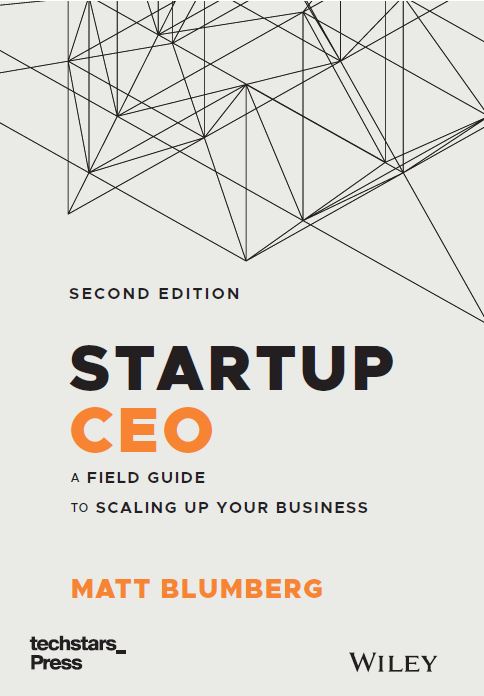
I’ve published two editions of Startup CEO, a sequel called Startup CXO, and am a co-author on the second edition of Startup Boards. We also just (2025) published mini-book versions of Startup CXO specifically for five individual functions, Startup CFO, Startup CRO, Startup CMO, Startup CPO, and Startup CTO.
You’re only a startup CEO once. Do it well with Startup CEO, a “master class in building a business.”
—Dick Costolo, Partner at 01A (Former CEO, Twitter)
Being a startup CEO is a job like no other: it’s difficult, risky, stressful, lonely, and often learned through trial and error. As a startup CEO seeing things for the first time, you’re likely to make mistakes, fail, get things wrong, and feel like you don’t have any control over outcomes.
As a Startup CEO myself, I share my experience, mistakes, and lessons learned as I guided Return Path from a handful of employees and no revenues to over $100 million in revenues and 500 employees.
Startup CEO is not a memoir of Return Path’s 20-year journey but a CEO-focused book that provides first-time CEOs with advice, tools, and approaches for the situations that startup CEOs will face.
You’ll learn:
How to tell your story to new hires, investors, and customers for greater alignment How to create a values-based culture for speed and engagement How to create business and personal operating systems so that you can balance your life and grow your company at the same time How to develop, lead, and leverage your board of directors for greater impact How to ensure that your company is bought, not sold, when you exit
Startup CEO is the field guide every CEO needs throughout the growth of their company and the one I wish I had.
“Startup CXO is an amazing resource for CEOs but also for functional leaders and professionals at any stage of their career.”
– Scott Dorsey, Managing Partner, High Alpha (Former CEO, ExactTarget)
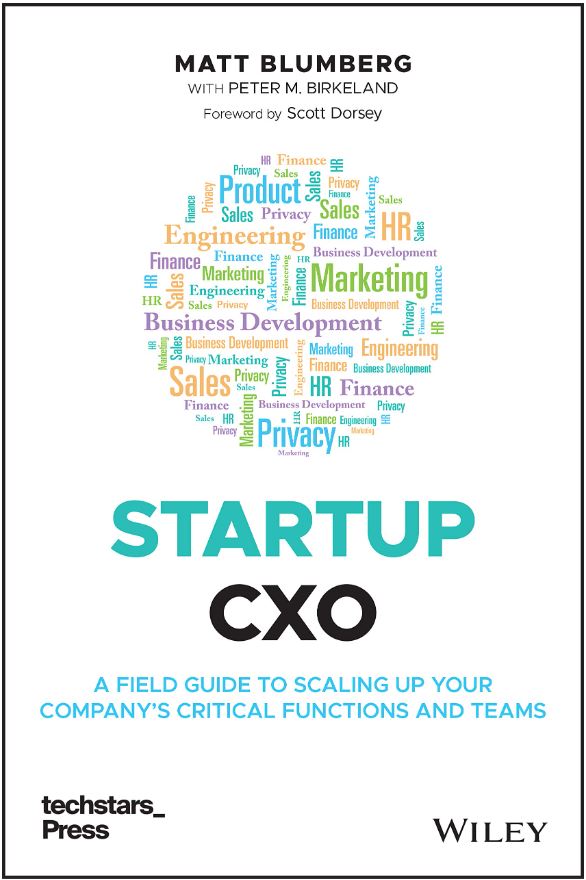
One of the greatest challenges for startup teams is scaling because usually there’s not a blueprint to follow, people are learning their function as they go, and everyone is wearing multiple hats. There can be lots of trial and error, lots of missteps, and lots of valuable time and money squandered as companies scale. My team and I understand the scaling challenges—we’ve been there, and it took us nearly 20 years to scale and achieve a successful exit. Along the way we learned what worked and what didn’t work, and we share these lessons learned in Startup CXO.
Unlike other business books, Startup CXO is designed to help each functional leader understand how their function scales, what to anticipate as they scale, and what things to avoid. Beyond providing function-specific advice, tools, and tactics, Startup CXO is a resource for each team member to learn about the other functions, understand other functional challenges, and get greater clarity on how to collaborate effectively with the other functional leads.
CEOs, Board members, and investors have a book they can consult to pinpoint areas of weakness and learn how to turn those into strengths. Startup CXO has in-depth chapters covering the nine most common functions in startups: finance, people, marketing, sales, customers, business development, product, operations, and privacy. Each functional section has a “CEO to CEO Advice” summary from me on what great looks like for that CXO, signs your CXO isn’t scaling, and how to engage with your CXO.
Startup CXO also has a section on the future of executive work, fractional and interim roles. Written by leading practitioners in the newly emergent fractional executive world, each function is covered with useful tips on how to be a successful fractional executive as well as what to look for and how to manage fractional executives.
A comprehensive guide on creating, growing, and leveraging a board of directors written for CEOs, board members, and people seeking board roles.

The first time many founders see the inside of a board room is when they step in to lead their board. But how do boards work? How should they be structured, managed, and leveraged so that startups can grow, avoid pitfalls, and get the best out of their boards? Authors Brad Feld, Mahendra Ramsinghani, and Matt Blumberg have collectively served on hundreds of startup and scaleup boards over the past 30 years, attended thousands of board meetings, encountered multiple personalities and situations, and seen the good, bad, and ugly of boards.
In Startup Boards: A Field Guide to Building and Leading an Effective Board of Directors, the authors provide seasoned advice and guidance to CEOs, board members, investors, and anyone aspiring to serve on a board. This comprehensive book covers a wide range of topics with relevant tips, tactics, and best practices, including:
- Board fundamentals such as the board’s purpose, legal characteristics, and roles and functions of board members;
- Creating a board including size, composition, roles of VCs and independent directors, what to look for in a director, and how to recruit directors;
- Compensating, onboarding, removing directors, and suggestions on building a diverse board;
- Preparing for and running board meetings;
- The board’s role in transactions including selling a company, buying a company, going public, and going out of business;
- Advice for independent and aspiring directors.
Startup Boards draws on the authors’ experience and includes stories from board members, startup founders, executives, and investors. Any CEO, board member, investor, or executive interested in creating an active, involved, and engaged board should read this book—and keep it handy for reference.
Five new mini-books from Startup CXO, but with new bonus material and an obvious focus on each specific functional area.
Each book has several topics in common – chapters on the nature of an executive’s role, how a fractional person works in that role, how the role works with the leadership team, how to hire that role, how the role works in the beginning of a startup’s life, how the role scales over time, and CEO:CEO advice about managing the role.

In Startup CTO (Technology and Product), the role-specific topics Shawn Nussbaum talks about are The Product Development Leaders, Product Development Culture, Technical Strategy, Proportional Engineering Investment and Managing Technical Debt, Shifting to a New Development Culture, Starting Things, Hiring Product Development Team Members, Increasing the Funnel and Building Diverse Teams, Retaining and Career Pathing People, Hiring and Growing Leaders, Organizing Collaborating with and Motivating Effective Teams, Due Diligence and Lessons Learned from a Sale Process, Selling Your Company, Preparation, and Selling Your Company/Telling the Story.

In Startup CMO, the role-specific topics Nick Badgett and Holly Enneking talk about are Generating Demand for Sales, Supporting the Company’s Culture, Breaking Down Marketing’s Functions, Events, Content & Communication, Product Marketing, Marketing Operations, Sales Development, and Building a Marketing Machine.

In Startup CFO, the role-specific topics Jack Sinclair talks about are Laying the CFO Foundation, Fundraising, Size of Opportunity, Financial Plan, Unit Economics and KPIs, Investor Ecosystem Research, Pricing and Valuation, Due Diligence and Corporate Documentation, Using External Counsel, Operational Accounting, Treasury and Cash Management, Building an In-House Accounting Team, International Operations, Strategic Finance, High Impact Areas for the Startup CFO as Partner, Board and Shareholder Management, Equity, and M&A.

In Startup CRO, the role-specific topics Anita Absey talks about are Hiring the Right People, Profile of Successful Sales People, Compensation, Pipeline, Scaling the Sales Organization, Sales Culture, Sales Process and Methodology, Sales Operating System, Marketing Alignment, Market Assessment & Alignment, Channels, Geographic Expansion, and Packaging & Pricing.

In Startup CPO (HR/People), the role-specific topics Cathy Hawley talks about are Values and Culture, Diversity Equity and Inclusion, Building Your Team, Organizational Design and Operating Systems, Team Development, Leadership Development, Talent and Performance Management, Career Pathing, Role Specific Learning and Development, Employee Engagement, Rewards and Recognition, Reductions in Force, Recruiting, Onboarding, Compensation, People Operations, and Systems.
Book Short: Legal Aid
Book Short: Legal Aid
The Entrepreneur’s Guide to Business Law, by Constance Bagley (HBS) and Craig Dauchy (Cooley Godward), while not exactly a page-turner, is a great reference book for even experienced CEOs. It’s pretty broad in its coverage of all major legal issues an entrepreneur will face, from patent law to firing employees.
Remember, you may make fun of lawyers on occasion or grips about their fees, but they DID attend law school for three years, after all. If nothing else, the $20 on this book will almost certainly save you at least 10x that in reduced legal fees someday, for something.
Book Short: Next, Write a Sequel
Book Short: Next, Write a Sequel
Written by Rodd Wagner and James K. Harter and billed as “the long awaited sequel to First, Break All the Rules” (one of the best management books I’ve ever read), I thought 12: The Elements of Great Managing, was good, but not great. 12…, along with the original book First… and Now, Discover Your Strengths, the latter two both by Marcus Buckingham, are all based on an extensive database of research done on corporate America by the Gallup organization over many years. All three are valuable reads in one way or another, although I found this to be the weakest of the three. (Note that Now… is different from the other two in that it’s not about management, it’s about self-management — very different, though based on the same research.)
Anyway, the elements of great managing, so say the authors, is all about creating employee engagement. I totally buy into that. And since no book short on 12… would be complete if it didn’t list out the 12…
1. Do I know what is expected of me at work?
2. Do I have the materials and equipment I need to do my work right?
3. At work, do I have the opportunity to do what I do best every day?
4. In the last seven days, have I received recognition or praise for doing good work?
5. Does my supervisor, or someone at work, seem to care about me as a person?
6. Is there someone at work who encourages my development?
7. At work, do my opinions seem to count?
8. Does the mission/purpose of my company make me feel my job is important?
9. Are my co-workers committed to doing quality work?
10. Do I have a best friend at work?
11. In the last six months, has someone at work talked to me about my progress?
12. This last year, have I had the opportunities at work to learn and grow?
The book fleshes out each of the 12, gives examples (some of which are better/clearer than others), and then addresses compensation in a very interesting chapter at the end. Key takeaways on comp:
– Higher pay doesn’t guarantee greater engagement
– Good and bad employees are equally likely to think they deserve a raise
– Money without meaning isn’t enough
– Most employees, most of the time, feel undercompensated
– Individual pay can/should be private, but comp criteria should be very public
– People who feel well-compensated generally work harder
The book also cites a very provocative article suggesting that organizations would handle comp better if they made everyone’s comp public (in contrast to the final bullet above, yes). I’m going to write more about compensation in future postings, so I’ll leave this section on those notes.
Finally, the book’s two closing thoughts are perhaps its most prescient: one critical element of BEING a great manager is HAVING a great manager; and the managers who put the most into their people, get the most out of their people.