
Political versus Corporate Leadership, Part II: Admitting Mistakes
Political versus Corporate Leadership, Part II: Admitting Mistakes
The press conference this past spring where President Bush embarrassingly refused to admit that he had ever made any big mistakes, other than to reiterate his gaffe at trading Sammy Sosa when he owned the Texas Rangers, brings up another issue in this series: is it good for leaders, both political and corporate, to admit mistakes?
On the corporate side, I think the ability to admit a mistake is a must. Again, I’ll refer back to Jim Collins’ books Good to Great and Built to Last, both of which talk about humility and the ability to admit mistakes as a critical component of emotional intelligence, the cornerstone of solid leadership. And in another great work on corporate leadership, The Fifth Discipline, writer Peter Senge talks about “learning systems” and the “learning organization” as far superior companies. My experience echoes this. Publicly admitting a mistake, along with a careful distillation of lessons learned, can go a long way inside a company to strengthening the bond between leader and team, regardless of the size of the company.
But in politics, the stakes are higher and weirder — and the organization is a nation, not a company. Publicly admitting a single mistake can be a leader’s downfall. It’s too easy these days for political opponents to seize on a mistake as a “flip flop” and turn a candidate’s own admission into a highly-charge negative ad.
There was a fantastic op-ed in The Wall Street Journal back on April 15 on this topic, which unfortunately doesn’t have an available link at the moment, entitled “Bush Enters a Political Quandary As He Faces Calls for an Apology.” I’ll try to both quote from and summarize the article here since it’s central to this topic:
“For a politician, is an apology a sign of weakness or strength? That is the debate now swirling around President Bush after a prime-time news conference in which he refused reporters’ invitations to acknowledge any specific mistakes in handling the issue of terrorism or offer an apology to Sept. 11 victims’ families. Mr. Bush deflected the invitation, saying, ‘Here’s what I feel about that: The person responsible for the attacks was Osama bin Laden.’ Mr. Bush’s quandary is a time-honored struggle for politicians. While some have found a public apology helps them out of a tough spot, others discovered it can fuel more criticism. So far, there isn’t a definitive answer.”
The article goes on to say that while Harry Truman’s “the buck stops here” mentality was de rigeur in the Beltway for a while (through Kennedy’s Bay of Pigs fiasco and Reagan’s poor handling of Beirut), nowadays, apologies are a dreaded last resort. The reason? The rise of partisanship and the use of ethics and congressional or special counsel investigations used to humiliate or defeat political opponents by raising the spectre of corruption. The examples? Gingrich’s struggles in 1996 over his book; Clinton’s ridiculous linguistics machinations (“it depends what the definition of ‘is’ is”) around the Lewinsky scandal; and Lott’s downfall over segregationist comments.
The piece wraps up by saying that “Mr. Bush was backed into the apology quandary by one of his administration’s toughest critics, former White House terrorism expert Richard Clarke…Since then, White House officials have been pressured to do likewise [apologize to victims’ families about the government’s failings on 9/11] — or explain why they won’t…[but] aides are convinced that admitting error would only embolden Mr. Bush’s critics in the Democratic Party and the news media.”
So the question is: would Bush be better off by saying “Sorry, folks, we thought there were WMD in Iraq, but it turns out we were wrong. And we miscalculated how difficult it would be to win the war, how many troops it would take, and how many lives would be lost. I still feel like it was right for us to go to war there for the following four reasons…”?
I’m not sure about that. He’d certainly be more intellectually honest, and a number of people in intellectual circles would feel better about him as a leader, but my guess is that he thinks it would cost him the election in today’s environment. My conclusion is that today’s system is discouraging politicians from admitting mistakes, and that it will take an exceptionally courageous leader (neither Bush nor Kerry as far as I can tell) to do so.
In the end, while humility appeals to many people in a leader, it’s not for everyone. Fortunately for us, CEOs don’t have to run for office and most CEOs don’t have to face some the same level of public, personally competitive, and media scrutiny that politicians do. Now that’s an interesting conclusion that I didn’t intend at the beginning of the post — being a good political leader and being a good politician are sometimes deeply at odds with each other.
Next up in the series: Not sure! Any ideas? Please comment on the blog site or by emailing me.
Startup CXO: the Sequel to Startup CEO
As I finished up my work on the Second Edition of Startup CEO: A Field Guide to Scaling Up Your Business and started working on a new startup, my colleagues and I started envisioning a new book as a sequel or companion to Startup CEO that is going to be published on June 9 with our same publisher, Wiley & Sons. The book is called Startup CXO: A Field Guide to Scaling Up Your Company’s Critical Functions and Teams.
Simply put, the first book left me with the nagging feeling that it wasn’t enough to only help CEOs excel, because starting and scaling a business is a collective effort. What about the other critical leadership functions that are needed to grow a company? If you’re leading HR, or Finance, or Marketing, or any key function inside a startup, what resources are available to you? What should you be thinking about? What does ‘great’ look like? What challenges lurk around the corner as you scale your function that you might not be focused on today? If you’re a CEO who has never managed all these functions before, what should you be looking for when you hire and manage all these people? If you’re an aspiring executive, from entry-level to manager to director, what do you need to think about as you grow your career and develop your skills?
Startup CXO is a “book of books,” with one section for each major function inside a company. Each section is be composed of 15-20 discrete short chapters outlining the key “playbooks” for each functional role in the company – Chief People Officer, Chief Financial Officer, Chief Marketing Officer, Chief Revenue Officer, etc., hence the title Startup CXO – which is a generally accepted label in the startup ecosystem for “Chief ____ Officer.”
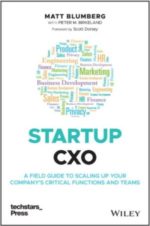
Here are the front and back covers of the book, with some great endorsements we’re so proud of on the back.


This is an important topic to write about at this particular time because America’s “startup revolution” continues to gather steam. There are only increasing numbers of venture capital investors, seed funds, and accelerators supporting increasing numbers of entrepreneurial ventures. While there are a number of books in the marketplace about CEOs and leadership, and some about individual functional disciplines (lots of books about the topic of Sales, the topic of Product Development), there are very few books that are practical how-to guides for any individual function, and NONE that wrap all these functions into a compendium that can be used by a whole startup executive team. Very simply, each section of this book serves as a how-to guide for a given executive, and taken together, the book will be a good how-to guide for startup executive teams in general.
Startup CXO has my name on it as principal author, and I’m writing parts of it, but I can’t even pretend to write it on my own, so the book has a large number of contributors who have the experience, credibility, and expertise to share something of value with others in their specific functional disciplines — most of my Bolster co-founders are writing sections, and the others are being written by former Return Path executive colleagues — Jack Sinclair, Cathy Hawley, Ken Takahashi, Anita Absey, George Bilbrey, Dennis Dayman, Nick Badgett, Shawn Nussbaum, and Holly Enneking.
Startup CXO is also pretty closely related to Bolster’s business, since we are in the business of helping assess and place on-demand CXO talent, and as such, the final section of the book has a series of chapters written by Bolster members who are career Fractional Executives about their experience as a Fractional CXO.
The book is available for pre-order now at Amazon and Barnes & Noble.
Oh, and stay tuned for a third book in the series (kind of) due out late this year. More on that over the summer as the project takes shape!
Book Short: Fables and Morals
Book Short: Fables and Morals
Courtesy of my colleague Stephanie Miller, I had a quick holiday read of Aesop & The CEO: Powerful Business Lessons from Aesop and America’s Best Leaders, by David Noonan, which I enjoyed. The book was similar in some ways to Squirrel, Inc., which I recently posted about, in that it makes its points by allegory and example (and not that it’s relevant, but that it relies on animals to make its points).
Noonan takes a couple dozen of Aesop’s ancient Greek fables and groups them in to categories like Rewards & Incentives, Management & Leadership, Strategy, HR, Marketing, and Negotiations & Alliances – and for each one, he gives modern-day management examples of the lessons.
For example, in the Wolf in Sheep’s Clothing, the lesson clearly is to strike while the iron is hot, or that a good plan executed today is better than a perfect one that’s too late. Noonan gives the example of Patton’s capture of Messina, Sicily during World War II.
And in The Hare & The Tortoise, where of course the moral is that slow & steady wins the race, Noonan gives the example of how New York Knicks coach Rick Pitino inspired Mark Jackson, who was chosen 18th in the NBA draft, to win the rookie of the year award in 1987 by helping him gain confidence by building on his strengths.
All in, a good read, even with that painful reminder that the Knicks used to have a decent basketball team.
The Beginnings of a Roadmap to Fix America’s Badly Broken Political System, part II
I wrote part I of this post in 2011, and I feel even more strongly about it today. I generally keep this blog away from politics (don’t we have enough of that running around?), but periodically, I find some common sense, centrist piece of information worth sharing. In this case, I just read a great and very short book, Six Amendments: How and Why We Should Change the Constitution, by former Supreme Court Justice John Paul Stevens, that, if you care about the polarization and fractiousness going on in our country now, you’d appreciate.
If nothing else, the shattered norms and customs of the last several years should point people to the fact that our Constitution needs some revision. Not a massive structural overhaul, but some changes on the margin to keep it fresh, as we approach its 250th anniversary in the next couple decades.
Startup CEO, Second Edition
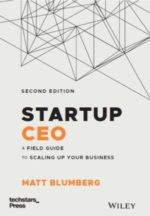
I haven’t taken a poll to figure out the overlap between people who read this blog and people that bought the first edition of Startup CEO, but I’m guessing there’s a high degree of it. If you are familiar with the book, I don’t want to bore you with a recap of what I wrote, but I thought I would devote the next several blogs to new ideas in the second edition. First, the new cover art from the publisher is kind of cool:

The first question you might have is, “Why a second edition? Didn’t you say everything you needed to say the first time?” The answer to that is, yes, I did say everything I had to say at the time, and the first edition is pretty comprehensive as a field guide. But that was about a dozen years into what turned out to be a 20-year journey, and after we sold Return Path in 2019, I had time to reflect on all that happened. I learned a lot of new lessons between the first and second editions, we had a lot of first-time experiences, we scaled the company significantly, and we sold it. None of those things are, in and of themselves, worthy of a second edition, but collectively they help tell the story of startup to exit and tell it from a perspective of creating a sustainable business over nearly two decades.
But there are other reasons, too, besides new lessons learned. Eight years is a lifetime in terms of changes to micro-trends, language, business in general, and the world around us. I wanted to update the book to make it contemporary so that it can speak to a new generation of CEOs. The second edition is more than a new cover and obvious updates on the number of employees or revenues. I added topics that reflect heightened responsibilities of CEOs around moral and ethical leadership in an increasingly transparent and socially conscious world. How do you navigate a politically charged and divisive society? For example, the State of Indiana passed a law intended to not force people to do things that contravened their religious beliefs but it had the side effect of legal descrimination against LGBT citizens. It was contentious, with rallying cries in business and society for one side or the other, and those same sentiments were found within our employee population.
How should CEOs handle a situation that conflicts with their core values? There are no easy answers, but avoiding them doesn’t make the problem go away.
Whether it’s the #metoo movement, high-profile failures of leadership like airline employees dragging customers off of planes, or something as simple as unconscious bias in the workplace, the best CEOs now need to approach their jobs differently. I didn’t write about that in the first edition, but the second edition has an entire chapter devoted to “Authentic Leadership” and provides guidelines and advice to help CEOs. The book went to press early in the COVID-19 pandemic and prior to all the protests around racial injustice surrounding the George Floyd killing, so nothing in it specifically addresses any of those issues. In some ways, though, that may be better at the moment since the book is more about frameworks and principles than about specific responses to current events.
I also added a new section with several chapters on the ins and outs of selling a business. Startup exits are the important culmination of the startup experience and something that the first edition only briefly touched on. Obviously, I was still CEO of a growing company and although we had an opportunity or two to sell within those first years, we never pulled the trigger. The first edition talks about that process at a surface level, but the second edition has far more content and detail since we had completed a sale transaction.
The first edition of the book has sold close to 40,000 copies as of the writing of the second edition, which blew me away when I tallied it all up. I’ve received many notes of thanks from readers all over the world for the book, and I’m glad that the content has proved useful to so many people, noting from some of the more critical reviews on Amazon that it certainly doesn’t scratch everyone’s itch. I hope the changes in the new edition add even more value to the lives of entrepreneurs and startup management teams. That’s really who the book is written for.
Here are some places to go to pre-order the book:
- Directly from the publisher, Wiley
- From Amazon
- From Books-a-Million
- From Indie Bound
- From BN.com
I have a limited number of free copies of the book that I can send out, and oddly, they are only print copies since the book publishing ecosystem hasn’t figured out an efficient way for authors to distribute free Kindle copies of books yet. As a bonus incentive for reading all the way to the end of this post, I will be happy to send a free copy to the first 5 people who comment on this post on the blog and ask for one.
Parenting and Corporate Leadership
Parenting and Corporate Leadership
Let me be clear up front: I do not think of my colleagues at Return Path as children, and I do not think of Casey, Wilson, and Elyse as employees. That said, after a couple weeks of good quality family time in January, I was struck by the realization that being a CEO for a long time before having kids has made me a better parent…and I think being a new parent the last three years has made me a better CEO.
Here's why. The two roles have a heavy overlap in required core interpersonal competencies. And doing both of them well means you're practicing those competencies twice as many hours in a week than just doing one – and in different settings. It's like cross training. In no order, the cross-over competencies I can think of are…
Decisiveness. Be wishy washy at work, and the team can get stuck in a holding pattern. Be wishy washy with kids, they run their agenda, not yours.
Listening. As my friend Anita says, you have two ears and one mouth for a reason. Listening to your team at work, and also listening for what's not being said, is the best way to understand what's going on in your organization. Kids need to be heard as well. The best way to teach good verbal communication skills is to ask questions and then listen actively and attentively to the responses.
Focus. Basically, no one benefits from multitasking, even if it feels like a more efficient way of working. Anyone you're spending time with, whether professionally or at home, deserves your full attention. The reality is that the human brain is full of entropy anyway, so even a focused conversation, meeting, or play time, is somehow compromised. Actually doing other activities at the same time destroys the human connection.
Patience. For the most part, steering people to draw their own conclusions about things at work is key. Even if it takes longer than just telling them what to do, it produces better results. With kids, patience takes on a whole new meaning, but giving them space to work through issues and scenarios on their own, while hard, clearly fosters independence.
Alignment. If you and your senior staff disagree about something, cross-communication confuses the team. If you and your spouse aren't on the same page about something, watch those kids play the two of you off each other. A united front at the top is key!
I'm sure there are others…but these are the main things that jump to mind. And of course one can be great in one area without being in the other area at all, or without being great in it. Are you a parent and a business leader? What do you think?
Reboot – The Fountainhead
Reboot – The Fountainhead
Happy New Year! Every few years or so, especially after a challenging stretch at work, I’ve needed to reboot myself. This is one of those times, and I will try to write a handful of blog posts on different aspects of that.
The first one is about a great book. I just read Ayn Rand’s The Fountainhead for (I think) the 5th time. It’s far and away my favorite book and has been extremely influential on my life. I think of it (and any of my favorite books) as an old friend that I can turn to in order to help center myself when needed as an entrepreneur and as a human. The last time I read it was over 10 years ago, which is too long to go without seeing one of your oldest friends, isn’t it? While the characters in the book by definition are somewhat extreme, the book’s guiding principles are great. I’ve always enjoyed this book far more than Atlas Shrugged, Rand’s more popular novel, which I think is too heavy-handed, and her much shorter works, Anthem and We The Living, which are both good but clearly not as evolved in her thinking.
As an entrepreneur, how does The Fountainhead influence me? Here are a few examples.
- When I think about The Fountainhead, the first phrase that pops into my head is “the courage of your convictions.” Well, there’s no such thing as being a successful entrepreneur without having the courage of your convictions. If entrepreneurs took “no” for an answer the first 25 times they heard it, there would be no Apple, no Facebook, no Google, but there’d also be no Ford, no GE, and no AT&T
- One great line from the book is that “the essence of man is his creative capacity.” Our whole culture at Return Path, and one that I’m intensely proud of, is founded on trust and transparency. We believe that if we trust employees with their time and resources, and they know everything going on in the company, that they will unleash their immense creative capacity on the problems to be solved for the business and for customers
- Another central point of influence for me from the book is that while learning from others is important, conventional wisdom only gets you far in entrepreneurship. A poignant moment in the book is when the main character, Howard Roark, responds to a question from another character along the lines of “What do you think of me?” The response is “I don’t think of you.” Leading a values-driven life, and running a values-driven existence, where the objective isn’t to pander to the opinion of others but to fill my life (and hopefully the company’s life) with things that make me/us happy and successful is more important to me than simply following conventional wisdom at every turn. Simply put, we like to do our work, our way, noting that there are many basics where reinventing the wheel is just dumb
- Related, the book talks about the struggle between first-handers and second-handers. “First-handers use their own minds. They do not copy or obey, although they do learn from others.” All innovators, inventors, and discoverers of new knowledge are first-handers. Roark’s speech at the Cortland Homes trial is a pivotal moment in the book, when he says, “Throughout the centuries, there were men who took first steps down new roads armed with nothing but their own vision. The great creators — the thinkers, the artists, the scientists, the inventors — stood alone against the men of their time. Every great new thought was opposed.” In other words, first-handers, critical thinkers, are responsible for human progress. Second-handers abdicate the responsibility of independent judgment, allowing the thinking of others to dominate their lives. They are not thinkers, they are not focused on reality, they cannot and do not build
- The “virtue of selfishness” is probably the essence of Rand’s philosophy. And it sounds horrible. Who likes to be around selfish people? The definition of selfish is key, though. It doesn’t inherently mean that one is self-centered or lacks empathy for others. It just means one stays true to one’s values and purpose and potentially that one’s actions start with oneself. I’d argue that selfishness on its own has nothing to do with whether someone is a good person or a good friend. For example, most of us like to receive gifts. But people give gifts for many different reasons – some people like to give gifts because they like to curry favor with others, other people like to give gifts because it makes them feel good. That’s inherently selfish. But it’s not a bad thing at all
- Finally, I’d say another area where The Fountainhead inspires me as a CEO is in making me want to be closer to the action. Howard Roark isn’t an ivory tower designer of an architect. He’s an architect who wants to create structures that suit their purpose, their location, and their materials. He only achieves that purpose by having as much primary data on all three of those things as possible. He has skills in many of the basic construction trades that are involved in the realization of his designs – that makes him a better designer. Similarly, the more time I spend on the front lines of our business and closer to customers, the better job I can do steering the ship
One area where I struggle a little bit to reconcile the brilliance of The Fountainhead with the practice of running a company is around collaboration. It’s one thing to talk about artistic design being the product of one man’s creativity, and that such creativity can’t come from collaboration or compromise. It’s another thing to talk about that in the context of work that inherently requires many people working on the same thing at the same time in a generalized way. Someday, I hope to really understand how to apply this point not to entrepreneurship, but to the collaborative work of a larger organization. I know firsthand and have also read that many, many entrepreneurs have cited Ayn Rand as a major influence on them over the years, so I’m happy to have other entrepreneurs comment here and let me know how they think about this particular point.
It feels a little shallow to try to apply a brilliant 700 page book to my life’s work in 1,000 words. But if I have to pick one small point to illustrate the connection at the end, it’s this. I realize I haven’t blogged much of late, and part of my current reboot is that I want to start back on a steady diet of blogging weekly. Why? I get a lot out of writing blog posts, and I do them much more for myself than for those who reads them. That’s a small example of the virtue of selfishness at work.
Book Short: Sequel Not Worth It
Book Short: Sequel Not Worth It
Mastering the 7 Essentials of High Growth Companies, by David Thomson, was a poor sequel to the solid Blueprint to a Billion [review] [buy]– and not worth reading if you’ve read the original. It was very short for its price and contained mildly interesting examples of “blueprint companies” that augmented the original book but didn’t uncover any new material or add any thinking to the mix. Basically, it was like another couple chapters that should have been part of Blueprint.
It is not a bad buy in lieu of the original if you haven’t read either one yet, as Blueprint is a bit longer than necessary, but otherwise, you can skip this one.
On a side note – the author’s interactive scorecard is a decent diagnostic tool (though also, I am sure, a lead gen tool for his consulting business).
Book Short: And It’s Not Just Because I’m In It
Book Short: And It’s Not Just Because I’m In It
Debbie Weil’s The Corporate Blogging Book is a good super quick read for any CEO or senior executive who is contemplating starting a blog — or even better, for those who have decided not to do so.
Weil’s writing style is great and very informal (blog-like, in fact) – a representative snippet is where she tells readers that there are two types of information to worry about posting on a blog, in her words, “stuff you don’t to reveal and stuff you could get sued for.” And her range of topics is great and deals with issues head-on. Things like fear of losing control, time commitment, and ghost writing are all well covered.
Chapter 8 also includes a great Cliff’s Notes guide to web 2.0 technologies — RSS, podcasting, wikis, tagging — which is useful if you still Feel Like a Luddite about those things.
I did contribute a couple interviews to the book, as did most of the other oft-cited CEO bloggers like Mark Cuban and Jonathan Schwartz in whose company I am somewhat embarrassed and humbled to be. But don’t let that deter you from picking up a copy if you are in the target audience!
Book Short: Why Wait?
A Sense of Urgency, by John Kotter, is a solid book – not his best, but worth a read and happily short, as most business books should be. I originally was going to hold off on writing this post until I had more time, but the subject matter alone made me think that was a mistake and that I should write it while it’s fresh in my mind. <g>
The three tools to fight complacency are the organizing framework for the book — bring the outside in, behave with urgency every day, and turn crises into opportunities — are all good thoughts, and good reminders of basic management principles. But there were a couple other themes worth calling out even more.
First up, the notion that there is a vicious cycle at play in that urgency begets success which creates complacency which then requires but does not beget urgency. The theme is really that success can drive arrogance, stability, and scale that requires inward focus — not that success itself is bad, just that it requires an extra level of vigilance to make sure it doesn’t lead to complacency. I’ve seen this cycle at different times over the years in lots of organizations, and it’s one of the reasons that if you look at the original companies on the Dow Jones Industrials index when it was expanded from 12 to 30 around 100 years ago, only one of them (GE) still exists.
Second, that busy-ness can masquerade as urgency but actually undermines urgency. A full calendar doesn’t mean you’re behaving with urgency. Kotter’s example of an Indian manager is great:
If you watch the Indian manager’s behavior carefully and contrast it with the hospital executive’s, you find that the former relentlessly eliminates low-priority items from his appointment diary. He eliminates clutter on the agenda of the meetings that do make it into his diary. The space that is freed up allows him to move faster. It allows him to follow up quickly on the action items that come out of meetings. The time freed up allows him to hold impromptu interactions that push along important projects faster. The open space allows him to talk more about issues he thinks are crucial, about what is happening with customers and competitors, and about the technological change affecting his business.
Finally, Kotter’s theme of “Urgent patience” is a wonderful turn of phrase. As he says,
It means acting each day with a sense of urgency but having a realistic view of time. It means recognizing that five years may be needed to attain important and ambitious goals, and yet coming to work each day committed to finding every opportunity to make progress toward those goals.
How true is that? It’s not just that big ships take a long time to turn…it’s that big opportunities take a long time to pursue and get right. If they didn’t…everyone would do them! Urgent patience is what allows you to install a bias for action in your team without causing panic and frenzy, which is never productive.
Thanks to my friend Chad Dickerson for recommending this book, a great read as part of Operation Reboot Matt.
Book Short – You’re in Charge – Now What?
Thanks to my friend and long-time former Board member Jeff Epstein, I recently downed a new book, You’re in Charge – Now What?, by Thomas Neff and James Citrin. I’m glad I read it. But it was one of those business books that probably should have just been a Harvard Business Review article. It’s best skimmed, with helpful short summaries at the end of every chapter that you could blow through quickly instead of hanging on every word.
The authors’ 8-step plan is laid out as:
- Prepare yourself during the countdown
- Align expectations
- Shape your management team
- Craft your strategic agenda
- Start transforming culture
- Manage your board/boss
- Communicate
- Avoid common pitfalls
Ok fine, those make sense on the surface. Here are three things that really stood out for me from the book:
First, “working” before you’re officially working – the countdown period. I tried hard NOT to do this when I was between things, but I’m glad I did the things I did, and now, I wish I had done more. The most poignant phrase in the book is “scarce time available during your first hundred days.” That is an understatement. As my “to read” pile grows and grows and grows with no end in sight…I wish I had done more pre-work.
Second, remember that in every interaction, you are being evaluated as much as you are evaluating. And note that for many people, they will be thinking very critically, things like “do I want to work with this person…is he/she showing signs that he/she wants to work with me?” Yes, we all know as leaders, we live in a fishbowl. But I think that may be even more true during the first couple months on the job.
Finally, this phrase stood out for me: “Acknowledging and in some cases embracing your predecessor can sustain a sense of continuity within the organization and instill a sense of connectivity with employees’ shared past.” There is frequently a temptation to focus on things that need change, which invariably there are…and which invariably you will hear from people who are happy to find a willing new ear to listen to them. But this posture of acknowledge/embrace is especially true in my case, where my predecessor is the founder and 25-year CEO who continues on as our active chairman.
I know there are a ton of books like this on the market, and while I’ve only read this one, I’d say that if you’re starting a new CEO or executive-level job, this is a good one to at least skim to get some ideas.