
Book Shorts: One Up, One Down
Book Shorts: One Up, One Down
I read new books by two of my favorite authors today: Geoffrey Moore and Seth Godin. Moore’s was his best book in years; Godin’s was his worst.
Geoffrey Moore’s latest book, Dealing with Darwin: How Great Companies Innovate at Every Phase of their Evolution, is Moore’s best book in a while. While I loved Crossing the Chasm and thought Inside the Tornado was a close second, both The Gorilla Game and Living on the Fault Line didn’t do it for me — they both felt like a pile of Silicon Valley buzzwords as opposed to the insightful and groundbreaking market definition in his first two books.
But Darwin is a gem. It goes back to Moore’s strengths in analyzing leading companies and creating a powerful framework for innovation that transcends industry and stage of company. And even better, the book has a few very useful “how to” lists to help readers interpret the content and adapt it to their own environments.
So whether you’re a Geoffrey Moore fan or not — assuming you are a fan of innovation and kicking your competitors’ collective butts — this book’s for you.
By contrast, Seth Godin’s Small Is the New Big is old news if you are a Seth Godin fan. It is literally a repackaging of essays, articles, and blog postings he’s written over the years. He’s trended down lately in his writing, like Moore (and most authors who have a single theme or two, it should be said), but unlike Moore, this book isn’t his recovery. The book is a must-have if you (a) love Seth’s writing and want a hard copy archive of his soft-copy stuff, (b) you don’t read Seth’s blog and want to see what you’ve been missing, or (c) you have his other books and are compulsive enough that you can’t stand incomplete collections.
Otherwise, wait for his next book, which hopefully will have some more of the original thinking and writing and ideas that made books like Permission Marketing, Unleashing the Ideavirus, and Purple Cow such new business classics. I have to say, the thing that disappointed me most here is that I felt like Seth totally sold out with this book — as a regular reader of his, I just felt duped by the Godin Marketing Machine, which is precisely the kind of thing he rants against. There was definitely NO Free Prize Inside this one.
Book Short: I Wish This Existed 12 Years Ago
Book Short: I Wish This Existed 12 Years Ago
Brad Feld has been on my board for over a decade now, and when he and his partner Jason Mendelson told me about a new book they were writing a bunch of months ago called Venture Deals: Be Smarter Than Your Lawyer and Venture Capitalist, I took note. I thought, “Hmmm. I’d like to be smarter than my lawyer or venture capitalist.”
Then I read an advanced copy. I loved it. At first, I thought, I would really have benefited from this when I started Return Path way back when. Then as I finished reading it, I realized it’s just a great reference book even now, all these years and financings later. But as much as I enjoyed the early read, I felt like something was missing from the book, since its intended audience is entrepreneurs.
Brad and Jason took me up on my offer to participate in the book’s content a little bit, and they are including in the book a series of 50-75 sidebars called “The Entrepreneur’s Perspective” which I wrote and which they and others edited. For almost every topic and sub-topic in the book, I chime in, either building on, or disagreeing, with Brad and Jason’s view on the subject.
The book is now out. As Brad noted in his launch post, the book’s table of contents says a lot:
- The Players
- How to Raise Money
- Overview of the Term Sheet
- Economic Terms of the Term Sheet
- Control Terms of the Term Sheet
- Other Terms of the Term Sheet
- The Capitalization Table
- How Venture Capital Funds Work
- Negotiation Tactics
- Raising Money the Right Way
- Issues at Different Financing States
- Letters of Intent – The Other Term Sheet
- Legal Things Every Entrepreneur Should Know
Fred has posted his review of the book as well.
Bottom line: if you are an aspiring or actual entrepreneur, buy this book. Even if you’ve done a couple of financings, this is fantastic reference material, and Brad and Jason’s points of view on things are incredibly insightful beyond the facts. And I hope my small contributions to the book are useful for entrepreneurs as well.
Book Short: Boards That Lead
Boards That Lead, by Ram Charan, Dennis Carey, and Michael Useem, was recommended to me by a CEO Coach in the Bolster network, Tim Porthouse, who said he’s been referring it to his clients alongside Startup Boards. I don’t exactly belong in the company of Ram Charan (Brad and Mahendra probably do!), so I was excited to read it. While it’s definitely the “big company” version to Startup Boards, there are some good lessons for startup CEOs and founder to take away from it.
The best part about the book as it relates to ALL boards is the framework of Partner, Take Charge, Stay out of the Way, and Monitor. You can probably lump all potential board activities into these four buckets. If you look at it that way…these are pretty logical:
- Monitor – what you’d expect any board to do
- Stay out of the Way – basic execution/operations
- Partner – strategy, goals, risk, budget, leadership talent development
- Take Charge – CEO hiring/firing, Exec compensation, Ethics, and Board Governance itself.
There was an interesting nugget in the book as well called the Central Idea that I hadn’t seen articulated quite this way before. It’s basically a statement of what the business is and how it’s going to win. It’s about a page long, 8-10 bullet points, and it includes things like mission, strategy, key goals, and key operating pillars that underlie the goals. It basically wraps up all of Lencioni’s key questions in one page with a little more meat on the bones. I like it and may adopt it. The authors put the creation of the Central Idea into the Take Charge bucket, but I’d put it squarely in the Partner bucket.
Other than that, the book is what you’d expect and does have a lot of overlap with the world of startups. Its criteria for director selection are very similar to what we use at Bolster, as is its director evaluation framework. The book has a ton of handy checklists as well, some of which are more applicable than others to startups, for example Dealing with Nonperforming Directors and Spotting a Failing CEO.
All in, a good read if you’re a student of Boards.
Use Cases to Bolster Your Team: How to Leverage On-Demand Talent in Your Business
(This post was written by my colleague Bethany Crystal and originally published on the Bolster blog yesterday. While I am still trying to figure out what posts to put on this blog vs. Bolster’s blog since the blogs are pretty similar, I will occasionally run something in both places.)
At Bolster, we believe that 2021 will mark the rise of the on-demand economy for executives. More than ever before, executives are seeking out roles that distinctly aren’t full-time for a variety of reasons – they’re in between full-time roles and want to stay engaged and meet a wide range of potential employers; they’re retired or semi-retired/post-exit and want to keep working, just not full-time; they’re fully employed but are looking for advisory opportunities to help others; or they are committed to the more flexible lifestyle that being an on-demand affords. As business leaders, you might be wondering how to take advantage of this trend and incorporate on-demand talent onto your existing team. Don’t worry – we’ve got you covered.
Let’s start with a quick primer on the distinct types of on-demand talent. Here are the four most common themes we see among our member network at Bolster:
The Four Types of On-Demand Talent
- Interim: Someone who is partially or fully dedicated to working with your company, but only temporarily (you can think of them as “filling a gap”)
- Fractional: Someone who works part-time (or “fractionally”) with your company on an ongoing basis (they “own” the function on a long-term, part-time basis)
- Advisor or Coach: Someone who supports your existing team by offering external advising, coaching, or mentorship as needed (this might be on a temporary or long-term basis)
- Project-Based: Someone who is brought on to complete a specific project or a fixed span of work (this is the closest to typical consulting work)
Depending on your business needs, the capacity of your existing team, and your resourcing, you might find it useful to have one or more on-demand executives in the mix at any given time. We’ve also found this can be a great way to keep things fresh at the leadership level and make sure new ideas are circulated with some regularity.
Business Opportunities for On-Demand Talent
While every company’s on-demand talent needs will vary, we’ve already seen a few patterns emerge from the 2,000 executives in our member network. Here are a few times to think about bringing on-demand work to your business.
Choose interim work if you need…
- A temporarily placeholder at the exec level
Whether unexpected or planned, transitions at the executive level can come with a high cost: Any week that goes by with an unfilled seat adds more work to the team, contributes to business lag, or both. While full executive searches can take six months (or more!) to get right, many CEOs find it helpful to bring on interim help as a “stopgap” in the meantime. The most obvious benefit of interim on-demand work is to prevent your business from falling behind in areas where you may not have a deep bench below the executive level. And you might also consider that bringing in a seasoned professional as you conduct your full-time search will give your team a proxy to compare against, making that placement process a bit easier. Last – while it’s not a guarantee, there’s always the chance that your interim hire is a great fit for you and wants to stick around for the long term! You then benefit from an on-the-job “interview” or audition. - Surge capacity staffing
Imagine a situation where your business doesn’t need an executive in a particular function. You’re small, scrappy, and you’re getting along perfectly well with the team you have in place – and you can fill in the bits of executive leadership required for that function yourself from time to time. But then something pops up where you need to be the CEO and can’t afford to ALSO be the CXO. An interim CXO could be the right solution. For example, the 3-5 months run-up to a Series A or B financing could be a good time to bring on an experienced CFO if your only relevant team members are handling AP, AR, and Payroll. Or you could be working on your company’s public launch with a less experienced marketing team and an agency – and an interim CMO could make all the difference between success and sideways. - Parental leave coverage
With a growing business trend of increased parental leave coverage, CEOs are starting to use interim executives to fill holes that might temporarily exist on the leadership team. Interim work is particularly useful if there isn’t an obvious “second in command” role on that team who might take on a stretch project in their absence. Implemented correctly, bringing on an interim exec can also help to squash any fears of “getting replaced” while someone is away on leave. As an added bonus, bringing in a new face (if only temporarily) can give the remaining team a chance to “try out” a new leadership style and share feedback about what worked and didn’t work during the interim period.
Choose fractional work if you need…
- A seasoned professional’s experience and skillset (but not all the time)
Before every full-time leadership hire, there is the sticky “in between” period of need. That’s the period when some work starts piling up, but not quite enough to fill an entire work week for one person at the executive level – or the period when you know you need a more seasoned leader in a function but just can’t afford one full-time. If you don’t have an experienced executive in the role, you miss opportunities for effectively setting up scalable practices and processes. Often, a lack of senior focus in a functional area means that you miss strategic opportunities, and sometimes it also means that you expose yourself to risk that could be avoided with the right person having ownership of the function. This is the perfect time to introduce fractional work to your business. The most classic example of fractional executive talent is the CFO who oversees the bookkeeping and accounting for several companies at once. But you can find a fractional executive for just about anything. You might consider this type of on-demand executive if you don’t yet have anyone in that functional area, if you have a team of less experienced specialists or even a more junior generalist leader in that functional area, if you want a taste of what it’d be like to dedicate more resources there, or if you need just a few things done right, without having to think about them yourself.
Choose advisory or coaching work if you need…
- Mentorship for your current executives
Sometimes it’s helpful to see what “great” looks like in order to achieve greatness yourself. If you’re looking for a way to give a current leader an added boost to their development plan, consider bringing on someone who can serve as a mentor or advisor on a temporary or long-term basis. Someone who has been in your shoes before and can give advice and guidance based on their experience. This on-demand exec role has two big benefits: The first being that it demonstrates to your executive team that you’re committed to their ongoing success and growth, which boosts morale (and hopefully performance). The second is that you’ll be able to equip your current team with the tools they each need to scale instead of having to bring on a new wave of executives for each business stage. The advisor or coach usually works a few hours per month, once they’ve set up a strong coaching relationship. - Access to top talent without the full-time price tag
Just as remote work unlocked the potential to find “the best of the best” without geographic constraints, on-demand work does the same at the executive level. More and more, we’re seeing CEOs incorporate advisors to their business as a way to gain exposure to best in class talent (at a fraction of the cost). This can be a great way to introduce subject matter or functional expertise into your organization without committing to a full-time salary.
Choose project work if you need…
- A fixed-scope expert engagement at the executive level
Just as tools like Task Rabbit made it possible to find experts to accomplish tasks on a personal level (such as moving furniture or painting a bedroom), on-demand talent makes it possible to find seasoned executives to complete one-off projects at an expert level. That’s why, on Bolster, we ask each each member to indicate what roles they can take on, and also what projects they can be hired to do. As a CEO, you might consider outsourcing some of the crunchy stuff at the exec level that might take a lot of time, or in cases where you need a quick turnaround to get to an MVP. Common projects we’ve seen to date include building sales commission plan structures, designing a go-to-market launch plan for a new product, running due diligence on an acquisition, overhauling pricing and packaging, working on a strategic plan, TAM analysis, budgeting process, or creating a diversity & inclusion strategy for the company. - An experimental project that won’t distract the current team
One final area where you might consider on-demand work is for a project that feels more like an addendum to your current business, or an early experiment. At Bolster, we brought on an on-demand executive to help us think through and roll out a brand new product that we’re in the early days of testing right now. We’ve seen other CEOs use project-based work at the exec level for things like evaluating market expansion possibilities or speccing out the MVP of a potential new product.
This is just a short list of some of the possibilities where on-demand talent might support you in your business today. One of our favorite parts about this type of work is just that – the flexibility it offers to you and your team. Whether your business is just getting started or if you’re operating on all cylinders, don’t forget to consider on-demand work as part of your CEO toolkit for this year and beyond.
– Bethany Crystal, February 2, 2021
Book Short (and great concept): Moments of Truth
Book Short (and great concept): Moments of Truth
TouchPoints: Creating Powerdul Leadership Connections in the Smallest of Moments, by Douglas Conant, former CEO of Campbell’s Soup Corporation, and Mette Norgaard (book, kindle), is a very good nugget of an idea wrapped in lots of other good, though only loosely connected management advice around self awareness and communication — something I’m increasingly finding in business books these days.
It’s a very short book. I read it on the Kindle, so I don’t know how many pages it is or the size of the font, but it was only 2900 kindles (or whatever you call a unit on the device) and only took a few Metro North train rides to finish. It’s probably worth a read just to get your head around the core concept a bit more, though it’s far from a great business book.
I won’t spend a lot of time on the book itself, but the concept echoes something I’ve been referring to a while here at Return Path as “Moments of Truth.” Moments of Truth are very short interactions between you and an employee that are high impact and, once you get the hang of them, low effort. At least, they’re low effort relative to long form meetings.
Here are a few thoughts about Moments of Truth:
- They are critical opportunities to get things both very right and very wrong with an employee
- They are more powerful than meets the eye – both for what they are and because they get amplified as employees mention them to other employees
- They can come to you (people popping into your office and the like), you can seek them out (management by walking around), and you can institutionalize them (for example, one of the things I do is call every employee on their Return Path anniversary to congratulate them on the milestone)
- They are no different than any other kind of interaction you have, just a lot shorter and therefore can be more intense (and numerous)
- Their use cases are as broad as any management interaction — coaching, positive or negative feedback, input, support, etc.
What can you as a manager or leader do to perfect your handling of Moments of Truth?
First, learn how to spot them when they come to you, and think about a typical employee’s day/week/month/year to think about when you can find opportunities to seek them out. Their first day on the job. When they get a promotion. When they get a great performance review, or new stock options. Maybe when they get a poor performance review or denied a promotion they were seeking.
Second, learn to appreciate them and leave space for them. If you have zero free minutes in every single day, you not only won’t have time to create or seek out Moments of Truth, you’ll be rushed or blow them off when they come to you.
Finally, like everything else, you have to develop a formula for handling them and then practice that formula. The book does talk about a formula of “head, heart, hand” (e.g., being logical, authentic, and competent) that’s not bad. Although I’d never thought about it systematically before writing this post, I have a few different kinds of Moments of Truth, and each one has its own rhythm to it, and its own regular ending.
But regardless of how you handle them, once you think about your day through this lens, you’ll start seeing them all over the place. Recognize their power, and dive in!
Book Short: You’d Never Run Your Business This Way…
Book Short: You’d Never Run Your Business This Way…
I am an unabashed conservative, so you might wonder what I was doing reading A Country That Works, by union chief Andy Stern, the President of SEIU (Service Workers International Union) this weekend. Well, part of it is that my mother-in-law Carmen works for him. Part was that he was quite inspiring during his recent appearance on the Colbert Report a week or two ago. And part was that I always like reading about different points of view, especially with the current, somewhat dismal state of the Republican leadership in Washington.
The book was very short and a worthwhile read. I may not agree with Stern on some of his illustrations of the problems — his statistical presentations were a bit apples-to-oranges at times — and some of his solutions, which were a bit high on the big-government-tax-and-spend side for me, but the book was very plain-speak, apolitical, and solution-oriented, all of which I found refreshing.
He certainly had at least one underlying premise about “labor as electricity ” (compete on something else other than forcing wages to go lower) that is making me think hard about my long-standing philosophical opposition to federally-mandated minimum wages. His notion of the importance of a global labor movement to act as a check/balance on corporate globalization both make sense. Actually, now that I think about it, those two things put together start working well as one plank in a solution to global poverty.
But the best part of the book was the fact that Stern is clear that, like his ideas or hate them, he is at least proposing that we DEAL with them. America is missing serious debate about some critical issues facing our society. Anyone who doesn’t think we have serious problems facing our future around retirement savings, education, and health care is not facing reality. The debate happening in Washington today is weak at best, and over-politicized.
The bottom line is that I think we’re in danger as a country of boiling the frog when it comes to some major structural issues in our society, and, most important to me, You’d Never Run Your Business This Way. Any good entrepreneur knows that when danger lurks around the corner, you have to reinvent yourself, and we as a country aren’t doing that at this moment when we’d benefit from it greatly for the long term. Stern displays that mix of optimism for the future and serious reality check today known as the Stockdale Paradox and revered by Jim Collins in his two books on corporate leadership, Good to Great and Built to Last.
My biggest criticism of the book was that it was too short. It was basically 1/3 Andy’s story, 1/3 SEIU’s story, and 1/3 labor’s story — and it could have been at least twice as long and gone into more detail on Stern’s points, especially in the last chapter where he starts spelling out his plan to get America back on track. But presumably when Stern runs for national office or gets a cabinet appointment someday (no inside knowledge here, but the book certainly reads that way), he’ll flesh things out a bit!
Book Short: Tales of Two Cities
Book Short: Tales of Two Cities
Return Path is basically dual-headquartered in New York City and Broomfield, Colorado, so two recently published books which provide history and insights into the tech industry in those two cities were both of interest to me.
Startup Communities: Building an Entrepreneurial Ecosystem in Your City, by Brad Feld (book, kindle) came out a few months ago and is part of Brad’s Startup Revolution series which will also include my upcoming book Startup CEO, to be published this fall. In the book, Brad uses the example of the Boulder/Denver area and a few different sectors to demonstrate a blueprint to creating an entrepreneurial ecosystem – the kind that are popping up all over the world of late.
Tech and the City: The Making of New York’s Startup Community, by Alessandro Piol (kindle only) hits on many of the same themes and topics as they relate to New York City, although the book is more of a history of the New York tech scene than a framework with examples. The book draws heavily on quotes from Fred Wilson, like Brad, a long time friend and Board member. One of the things the book left me thinking about was what the New York tech scene will look like in 30 years after the new Cornell-Technion campus is up and running. That plus the current momentum of the tech industry in New York, plus the sheer commercial scale of the city, could really produce an interesting environment down the road that actually starts to rival Silicon Valley, though rival probably isn’t the right word.
All in, these two books do a good job of chronicling the industry I work in, in the two cities where I work, but they also abstract nicely to broader principles about public-private collaboration as well as sector development.
Book Short: Blink Part II
Book Short: Blink Part II
Years ago I wrote a post about Malcolm Gladwell’s excellent book, Blink (post, buy). While my post has lots of specifics in it for entrepreneurs, for VCs, and for marketers, my quick summary was this:
Where The Tipping Point theorizes about how humans relate to each other and how fads start and flourish in our society, Blink theorizes about how humans make decisions and about the interplay between the subconscious, learned expertise, and real-time inputs. But Gladwell does more than theorize — he has plenty of real world examples which seem quite plausible, and he peppers the book with evidence from some (though hardly a complete coverage of relevant) scientific and quasi-scientific studies.
I recently finished another book, Thinking Fast, and Slow, by Daniel Kahneman, which was very similar. I’d call it the academic version of Blink, or that Blink is the journalistic version of it. Kahneman breaks down our ability to think and process information into what he calls System 1 (quick and intuitive) and System 2 (slower, rational and logical). As he puts it:
In summary, most of what you (your System 2) think and do originates in your System 1, but System 2 takes over when things get difficult, and it normally has the last word.
The book is rich in examples, and while it’s a bit long and sometimes slow going, it is an excellent read if you want to learn more about how the brain works. The work applications are many – we do a lot of work at Return Path on understanding and avoiding Unconscious Bias at work – and this book gave me a bunch of good ideas around that. It’s clear that it’s impossible to become a true master of your intuition vs. logic, but you can design some systems, or at least insert some checks and balances into other systems, to blunt the impact of faulty intuition or lazy logic. The book also has an overwhelming number of labels it applies to common situations – great, but hard to keep them all straight (the priming effect, anchors, endowment effect, etc.).
Perhaps the most interesting thing for me to ponder as an entrepreneur, though, was the section on Loss Aversion (another great label). It turns out we humans are motivated more by fear of loss than by the prospect of gain. A poignant example in the book is that professional golfers make a higher percentage of putts (I forget the actual number, but a real one, like 3-5%) for par than for birdie, when the putts are like-for-like in terms of distance and difficulty. Saving par is more of a motivator than being under par. The application for work is interesting. As companies get larger, it can be difficult for founders and management teams to maintain the same level of bold risk-taking they did as smaller organizations. Having something to lose is harder than having nothing to lose. And yet, as they say, fortune favors the bold. Growth stage companies need to figure out how to institutionalize risk taking and experimentation, including putting enough resources into those activities that will generate future growth, rather than simply protecting what’s already running. (Of course, what’s already running needs investment, too.)
Thanks to my colleagues Dragana and Richard for recommending this book, and to Jamie for facilitating our office book club around it this month!
The Best Place to Work, Part 4: Be the Consummate Host
The Best Place to Work, Part 4: Be the Consummate Host
Besides Surrounding yourself with the best and brightest , Creating an environment of trust, and Managing yourself very, very well, it’s important for you as a creator of The Best Place to Work to Be the Consummate Host.
What does that mean? This is how I approach my job every day. I think of the company as a party, where I’m the host. I want everyone to have a good time. To get along with the other guests. To be excited to come back the next time I have a party (e.g., every day).
By the way, I always have co-hosts, as well – anyone who manages anyone in the company. If I can’t do something specific below, someone on my executive team does it. Sometimes, two of us do it! Examples include:
- I interview people like I’m a bouncer at an exclusive club. We do very personal new employee orientations. We do personal check-ins after 30 and 90 days to make sure new employees are on track
- I attend every company function that I can and work the room as a host, even if it’s not “my” event – sometimes it means sacrificing long conversations and conversations with friends for smaller ones and meeting new people
- I call every employee (voicemail ok) and write a note and/or send a gift every anniversary of their employment with the company
- I write notes to people when they do something great or get a promotion
Full series of posts here.
Books
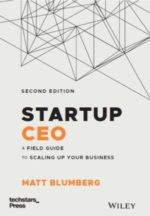
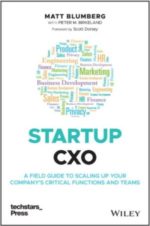
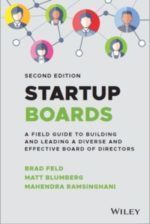
I’ve published two editions of Startup CEO, a sequel called Startup CXO, and am a co-author on the second edition of Startup Boards. We also just (2025) published mini-book versions of Startup CXO specifically for five individual functions, Startup CFO, Startup CRO, Startup CMO, Startup CPO, and Startup CTO.
You’re only a startup CEO once. Do it well with Startup CEO, a “master class in building a business.”
—Dick Costolo, Partner at 01A (Former CEO, Twitter)
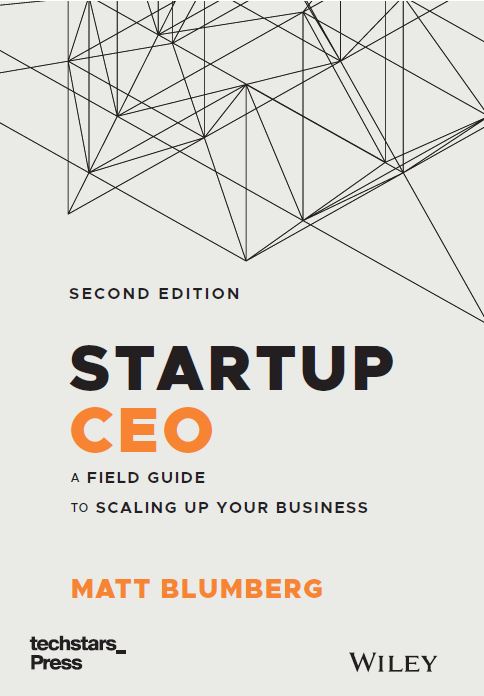
Being a startup CEO is a job like no other: it’s difficult, risky, stressful, lonely, and often learned through trial and error. As a startup CEO seeing things for the first time, you’re likely to make mistakes, fail, get things wrong, and feel like you don’t have any control over outcomes.
As a Startup CEO myself, I share my experience, mistakes, and lessons learned as I guided Return Path from a handful of employees and no revenues to over $100 million in revenues and 500 employees.
Startup CEO is not a memoir of Return Path’s 20-year journey but a CEO-focused book that provides first-time CEOs with advice, tools, and approaches for the situations that startup CEOs will face.
You’ll learn:
How to tell your story to new hires, investors, and customers for greater alignment How to create a values-based culture for speed and engagement How to create business and personal operating systems so that you can balance your life and grow your company at the same time How to develop, lead, and leverage your board of directors for greater impact How to ensure that your company is bought, not sold, when you exit
Startup CEO is the field guide every CEO needs throughout the growth of their company and the one I wish I had.
“Startup CXO is an amazing resource for CEOs but also for functional leaders and professionals at any stage of their career.”
– Scott Dorsey, Managing Partner, High Alpha (Former CEO, ExactTarget)
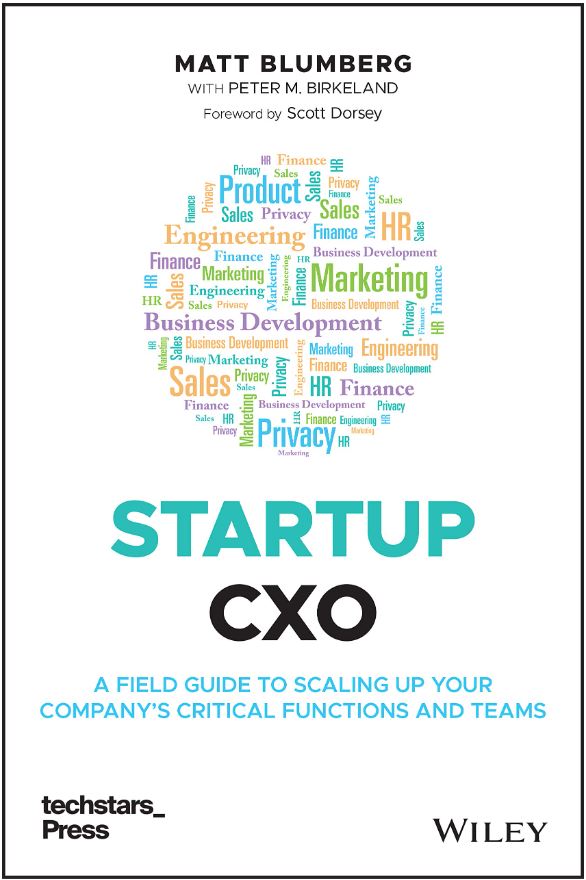
One of the greatest challenges for startup teams is scaling because usually there’s not a blueprint to follow, people are learning their function as they go, and everyone is wearing multiple hats. There can be lots of trial and error, lots of missteps, and lots of valuable time and money squandered as companies scale. My team and I understand the scaling challenges—we’ve been there, and it took us nearly 20 years to scale and achieve a successful exit. Along the way we learned what worked and what didn’t work, and we share these lessons learned in Startup CXO.
Unlike other business books, Startup CXO is designed to help each functional leader understand how their function scales, what to anticipate as they scale, and what things to avoid. Beyond providing function-specific advice, tools, and tactics, Startup CXO is a resource for each team member to learn about the other functions, understand other functional challenges, and get greater clarity on how to collaborate effectively with the other functional leads.
CEOs, Board members, and investors have a book they can consult to pinpoint areas of weakness and learn how to turn those into strengths. Startup CXO has in-depth chapters covering the nine most common functions in startups: finance, people, marketing, sales, customers, business development, product, operations, and privacy. Each functional section has a “CEO to CEO Advice” summary from me on what great looks like for that CXO, signs your CXO isn’t scaling, and how to engage with your CXO.
Startup CXO also has a section on the future of executive work, fractional and interim roles. Written by leading practitioners in the newly emergent fractional executive world, each function is covered with useful tips on how to be a successful fractional executive as well as what to look for and how to manage fractional executives.
A comprehensive guide on creating, growing, and leveraging a board of directors written for CEOs, board members, and people seeking board roles.

The first time many founders see the inside of a board room is when they step in to lead their board. But how do boards work? How should they be structured, managed, and leveraged so that startups can grow, avoid pitfalls, and get the best out of their boards? Authors Brad Feld, Mahendra Ramsinghani, and Matt Blumberg have collectively served on hundreds of startup and scaleup boards over the past 30 years, attended thousands of board meetings, encountered multiple personalities and situations, and seen the good, bad, and ugly of boards.
In Startup Boards: A Field Guide to Building and Leading an Effective Board of Directors, the authors provide seasoned advice and guidance to CEOs, board members, investors, and anyone aspiring to serve on a board. This comprehensive book covers a wide range of topics with relevant tips, tactics, and best practices, including:
- Board fundamentals such as the board’s purpose, legal characteristics, and roles and functions of board members;
- Creating a board including size, composition, roles of VCs and independent directors, what to look for in a director, and how to recruit directors;
- Compensating, onboarding, removing directors, and suggestions on building a diverse board;
- Preparing for and running board meetings;
- The board’s role in transactions including selling a company, buying a company, going public, and going out of business;
- Advice for independent and aspiring directors.
Startup Boards draws on the authors’ experience and includes stories from board members, startup founders, executives, and investors. Any CEO, board member, investor, or executive interested in creating an active, involved, and engaged board should read this book—and keep it handy for reference.
Five new mini-books from Startup CXO, but with new bonus material and an obvious focus on each specific functional area.
Each book has several topics in common – chapters on the nature of an executive’s role, how a fractional person works in that role, how the role works with the leadership team, how to hire that role, how the role works in the beginning of a startup’s life, how the role scales over time, and CEO:CEO advice about managing the role.

In Startup CTO (Technology and Product), the role-specific topics Shawn Nussbaum talks about are The Product Development Leaders, Product Development Culture, Technical Strategy, Proportional Engineering Investment and Managing Technical Debt, Shifting to a New Development Culture, Starting Things, Hiring Product Development Team Members, Increasing the Funnel and Building Diverse Teams, Retaining and Career Pathing People, Hiring and Growing Leaders, Organizing Collaborating with and Motivating Effective Teams, Due Diligence and Lessons Learned from a Sale Process, Selling Your Company, Preparation, and Selling Your Company/Telling the Story.

In Startup CMO, the role-specific topics Nick Badgett and Holly Enneking talk about are Generating Demand for Sales, Supporting the Company’s Culture, Breaking Down Marketing’s Functions, Events, Content & Communication, Product Marketing, Marketing Operations, Sales Development, and Building a Marketing Machine.

In Startup CFO, the role-specific topics Jack Sinclair talks about are Laying the CFO Foundation, Fundraising, Size of Opportunity, Financial Plan, Unit Economics and KPIs, Investor Ecosystem Research, Pricing and Valuation, Due Diligence and Corporate Documentation, Using External Counsel, Operational Accounting, Treasury and Cash Management, Building an In-House Accounting Team, International Operations, Strategic Finance, High Impact Areas for the Startup CFO as Partner, Board and Shareholder Management, Equity, and M&A.

In Startup CRO, the role-specific topics Anita Absey talks about are Hiring the Right People, Profile of Successful Sales People, Compensation, Pipeline, Scaling the Sales Organization, Sales Culture, Sales Process and Methodology, Sales Operating System, Marketing Alignment, Market Assessment & Alignment, Channels, Geographic Expansion, and Packaging & Pricing.

In Startup CPO (HR/People), the role-specific topics Cathy Hawley talks about are Values and Culture, Diversity Equity and Inclusion, Building Your Team, Organizational Design and Operating Systems, Team Development, Leadership Development, Talent and Performance Management, Career Pathing, Role Specific Learning and Development, Employee Engagement, Rewards and Recognition, Reductions in Force, Recruiting, Onboarding, Compensation, People Operations, and Systems.
Book short: Proto Gladwell
Book short: Proto Gladwell
I’m sure author Robert Cialdini would blanch if he read this comparison, but then again, I can’t be the first person to make it, either. His book, Influence: The Psychology of Persuasion, is an outstanding read for any marketing or sales professional, but boy does it remind me of Malcolm Gladwell’s The Tipping Point and Blink (book; blog post). Of course, Cialdini’s book came out a decade before Gladwell’s! Anyway, Influence is a great social science look at the psychology that makes sales and marketing work.
Cialdini talks about sales and marketing professionals as “compliance practitioners,” which is a great way to think about them, quite frankly. He boils down the things that make sales and marketing work to six core factors: consistency, reciprocation, social proof, authority, liking, and scarcity.
Reciprocation – we hate being in a state of being beholden so much that we might even be willing to do a larger favor than the one done for us in order to remove the state. Think about “free gifts” in merchandising as an example of this, or being in a negotiation where someone trying to make a cold sale on you offers a fallback, smaller sale. For example, you don’t want to buy anything from the boy scout, but after you say no to the $5 raffle ticket and he asks about the $1 candy bar, you feel more obligated to buy the $1 candy bar because the boy scout has “given” on his initial request.
Consistency – once we have made a choice, personal and interpersonal pressures force us to back it up and justify our earlier decision – even more so when in writing or when declared to others. This is why marketers love getting testimonials from customers; the testimonial locks the customer in emotionally, as well as encouraging others to buy the product.
Social proof – if others think it’s correct, it must be correct, especially if those other people are like us. There are some scary examples in the book here, such as Reverand Jim Jones and The People’s Temple mass suicides. Gripping, but creepy.
Liking – we listen to people we like, and we like people to whom we’re similar or who are physically attractive. This section was especially reminiscent of Blink, but with different and more marketer-focused examples.
Authority – we have an extreme willingness to listen to authority, even when the authority isn’t quite relevant. This is why celebrity endorsements work so well.
Scarcity – we have a extreme motivation of fear of loss, either or something, or of the opportunity to have something. Who doesn’t like to keep doors open as long as possible?
The one place the book falls down a little bit is in the sections at the end of each chapter talking about how to resist that particular technique through jujitsu – the art of “turning the enemy’s strength to your advantage.” While nice in theory, Cialdini’s examples aren’t super helpful beyond saying “when you think you’re getting suckered, stop — and then say no.”
Overally, though, the book is well written and choc full of examples. Thanks to marketer Mallory Kates for sending me this great book!