
Book Short: The Challenger Sale
Book Short: The Challenger Sale
I’ve written a couple times in the past about how we sell at Return Path. I’ve written about our principle sales methodology for the past decade, SPIN Selling, by Neil Rackham (and Major Account Strategy, also by Rackham, which is basically SPIN Selling for Account Managers), which focuses on a specific technique for solution selling by using questioning to get the prospective client to identify his or her own needs, as well as Jeffrey Gitomer’s two short books, the Little Red Book of Selling and Little Red Book of Sales Answers, which are long on sales questioning techniques. And I also wrote this post about another book called Why People Don’t Buy Things, by Kim Wallace and Harry Washburn. The great thing about this book is that it dives into the need for variation in sales communication strategies based on BUYER personae, such as The Commander, The Thinker, and The Visualizer.
While both these principles are good – asking questions and tailoring communication styles based on the buyer – anyone who has ever tried to run a whole sales call by asking questions knows that it’s REALLY HARD and can sometimes just outright flop. There’s a new movement that I’ve been reading articles about for a few months now called The Challenger Sale, and I finally finished the book about it this past week.
If you run a company or a sales team that has any kind of complex sale or a hybrid software/service model, then you should read The Challenger Sale: Taking Control of the Customer Conversation, by Matthew Dixon and Brent Adamson. Whether you adopt the methodology or not, there are a few really great insights in the book that will help you recruit and manage a sales team. Some of the insights include:
- Understanding the five types of sales reps and why/when they’re successful/not successful. The labels are telling in and of themselves: the Lone Wolf, the Hard Worker, the Relationship Building, the Reactive Problem Solver, and the Challenger
- Why sales reps can be trained as Challengers, and how important it is to rally an entire organization around this sales model, not just train sales reps on it (that’s probably a good reminder for any sales methodology)
- The ingredients of the Challenger sale – Commercial Teaching for Differentiation, Tailoring for Resonance, Taking Control of the Conversation. I found the section on Commercial Teaching the most enlightening, particularly in our business, where we’re not selling an established category with established budget line items
The Challenger Sale feels like the beginning of a wave that will take over a lot of selling organizations in the next decade, either directly as written or as it inspires ancillary works and related techniques. For that reason alone, it’s worth a read.
Book Short: Internet Fiction
Book Short: Internet Fiction
It’s been a long time since I read Tom Evslin’s Hackoff.com, which Tom called a “blook” since he released it serially as a blog, then when it was all done, as a bound book. Mariquita and I read it together and loved every minute of it. One post I wrote about it at the time was entitled Like Fingernails on a Chalkboard.
The essence of that post was “I liked it, but the truth of the parts of the Internet bubble that I lived through were painful to read,” applies to two “new” works of Internet fiction that I just plowed through this week, as well.
Uncommon Stock
Eliot Pepper’s brand new startup thriller, Uncommon Stock, was a breezy and quick read that I enjoyed tremendously. It’s got just the right mix of reality and fantasy in it. For anyone in the tech startup world, it’s a must read. But it would be equally fun and enjoyable for anyone who likes a good juicy thriller.
Like my memory of Hackoff, the book has all kinds of startup details in it, like co-founder struggles and a great presentation of the angel investor vs. VC dilemma. But it also has a great crime/murder intrigue that is interrupted with the book’s untimely ending. I eagerly await the second installment, promised for early 2015.
The Circle
While not quite as new, The Circle has been on my list since it came out a few months back and since Brad’s enticing review of it noted that:
The Circle was brilliant. I went back and read a little of the tech criticism and all I could think was things like “wow – hubris” or “that person could benefit from a little reflection on the word irony”… We’ve taken Peter Drucker’s famous quote “‘If you can’t measure it, you can’t manage it” to an absurd extreme in the tech business. We believe we’ve mastered operant conditioning through the use of visible metrics associated with actions individual users take. We’ve somehow elevated social media metrics to the same level as money in the context of self-worth.
So here’s the scoop on this book. Picture Google, Twitter, Facebook, and a few other companies all rolled up into a single company. Then picture everything that could go wrong with that company in terms of how it measures things, dominates information flow, and promotes social transparency in the name of a new world order. This is Internet dystopia at its best – and it’s not more than a couple steps removed from where we are. So fiction…but hardly science fiction.
The Circle is a lot longer than Uncommon Stock and quite different, but both are enticing reads if you’re up for some internet fiction.
Book Short: Fixing America
Book Short: Fixing America
I usually only blog about business books, but since I occasionally comment on politics, I thought I would also post on That Used to be Us: How America Fell Behind in the World It Invented and How We Can Come Back, by Tom Friedman and Michael Mandelbaum (book, Kindle), which I just finished.
There is much that is good about America. And yet, there is much that is broken and in need of serious repair. I wrote about some thought on fixing our political system last year in The Beginnings of a Roadmap to Fix America’s Badly Broken Political System?, but fixing our political system can only do so much. Tom Friedman, with whom I usually agree a lot, but only in part, nailed it in his latest book. Instead of blaming one party or the other (he points the finger at both!), he blames our overall system, and our will as a people, for the country’s current problems.
The authors talk about the four challenges facing America today – globalization, the IT revolution, deficits and debt, and rising energy demand and climate change, and about how the interplay of those four challenges are more long term and less obvious than challenges we’ve faced as a country in the past, like World Wars or The Great Depression, or even The Great Recession. The reason, according to the authors, that we have lost our way a bit in the last 20-40 years, is that we have strayed from the five-point formula that has made us successful for the bulk of our history:
- Providing excellent public education for more and more Americans
- Building and continually modernizing our infrastructure
- Keeping America’s doors to immigration open
- Government support for basic research and development
- Implementation of necessary regulations on private economic activity
It’s hard not to be in violent agreement with the book as a normal person with common sense. Even the last point of the five-point formula, which can rankle those on the right, makes sense when you read the specifics. And the authors rail against excessive regulation enough in the book to give them credibility on this point.
The authors’ description of the labor market of the future and how we as a country can be competitive in it is quite well thought through. And they have some other great arguments to make – for example, about how the prior decade of wars was, for the first time in American history, not accompanied by tax increases and non-essential program cuts; or about how we can’t let ourselves be held hostage to AARP and have “funding old age” trump “funding youth” at every turn.
The one thing I disagree with a bit is the authors’ assertion that “we cannot simply cut our way to fiscal sanity.” I saw a table in the Wall Street Journal the same day I was reading this book that noted the federal budget has grown from $2.6T in 2007 to $3.6T today – 40% in four years! Sure sounds to me like mostly a spending program, though I do support closing loopholes, eliminating subsidies, and potentially some kind of energy tax for other reasons.
I’ll save their solution for those who read the book. It’s not as good as the meat of the book itself, but it’s solid, and it actually mirrors something my dad has been talking about for a while now. If you care about where we are as a country and how we can do better, read this book!
Running a Productive Offsite
Running a Productive Offsite
A couple OnlyOnce readers asked me to do a post on how I run senior team offsites. It’s a great part of our management meeting routine at Return Path, and one that Patrick Lencioni talks about extensively in Death by Meeting (review, book) – a book worth reading if you care about this topic.
My senior team has four offsites per year. I love them. They are, along with my Board meetings, my favorite times of the year at work. Here’s my formula for these meetings:
– WHY: There are a few purposes to our offsites. One for us is that our senior team is geographically distributed across 4 geographies at the executive level and 6 or 7 at the broader management team level. So for us, these are the only times of the year that we are actually in the same place. But even if we were all in one place, we’d still do them. The main purpose of the offsite is to pull up from the day-to-day and tackle strategic issues or things that just require more uninterrupted time. The secondary purpose is to continue to build and develop the team, both personal relationships and team dynamics. It’s critically important to build and sustain deep relationships across the Executive Team. We need this time in order to be a coordinated, cohesive, high trust, aligned leadership team for the company. As the company has expanded (particularly to diverse geographies), our senior team development has become increasingly critical
– WHO: Every offsite includes what we call our Executive Committee, which is for the most part, my direct reports, though that group also includes a couple C/SVP titled people who don’t report directly to me but who run significant parts of the company (7-8 people total). Two of the four offsites we also invite the broader leadership team, which is for the most part all of the people reporting into the Executive Committee (another 20 people). That part is new as we’ve gotten bigger. In the earlier days, it was just my staff, and maybe one or two other people as needed for specific topics
– WHERE: Offsites aren’t always offsite for us. We vary location to make geography work for people. And we try to contain costs across all of them. So every year, probably 2 of them are actually in one of our offices or at an inexpensive nearby hotel. Then the other 2 are at somewhat nicer places, usually one at a conference-oriented hotel and then one at a more fun resort kind of place. Even when we are in one of our offices, we really treat it like an offsite – no other meetings, etc., and we make sure we are out together at dinner every night
– WHEN: 4x/year at roughly equal intervals. We used to do them right before Board meetings as partial prep for those meetings, but that got too crowded. Now we basically do them between Board meetings. The only timing that’s critical is the end of year session which is all about budgeting and planning for the following year. Our general formula when it’s the smaller group is two days and at least one, maybe two dinners. When it’s the larger group, it’s three days and at least two dinners. For longer meetings, we try to do at least a few hours of fun activity built into the schedule so it’s not all work.
– WHAT: Our offsites are super rigorous. We put our heads together to wrestle with (sometimes solve) tough business problems – from how we’re running the company, to what’s happening with our culture, to strategic problems with our products, services and operations. The agenda for these offsites varies widely, but the format is usually pretty consistent. I usually open every offsite with some remarks and overall themes – a mini-state-of-the-union. Then we do some kind of “check-in” exercise either about what people want to get out of the offsite, or something more fun like an envisioning exercise, something on a whiteboard or with post-its, etc. We always try to spend half a day on team and individual development. Each of us reads out our key development plan items from our most recent individual 360, does a self-assessment, then the rest of the team piles on with other data and opinions, so we keep each other honest and keep the feedback flowing. Then we have a team development plan check-in that’s the same, but about how the team is interacting. We always have one or two major topics to discuss coming in, and each of those has an owner and materials or a discussion paper sent out a few days ahead of time. Then we usually have a laundry list of smaller items ranging from dumb/tactical to brain-teasing that we work in between topics or over meals (every meal has an agenda!). There’s also time at breaks for sub-group meetings and ad hoc conversations. We do try to come up for air, but the together time is so valuable that we squeeze every drop out of it. Some of our best “meetings” over the years have happened side-by-side on elliptical trainers in the hotel gym at 6 a.m. We usually have a closing check-out, next steps recap type of exercise as well.
– HOW: Lots of our time together is just the team, but we usually have our long-time executive coach Marc Maltz from Triad Consulting facilitate the development plan section of the meeting.
I’m sure I missed some key things here. Team, feel free to comment and add. Others with other experiences, please do the same!
Book Short: Must-Read for CXOs
Lead Upwards: How Startup Joiners Can Impact New Ventures, Build Amazing Careers, and Inspire Great Teams, by Sarah E. Brown, is an amazing book – and one that fits really well with our Startup Revolution series, in particular our book Startup CXO.
I kept thinking as I was reading it that it was the other side of the proverbial coin…that Startup CXO was about the details of each executive job in a company…but Sarah’s book is about the things common to ALL executive jobs – how to get them, how to succeed at them, essentially how to BE an executive. I read it front to back in a single day one weekend and loved it.
Some of the most insightful moments in her book are:
- Why big company executives who join startups often struggle
- How to get promoted by proactively doing the next job – act “as if” – while still excelling at your current job
- The importance of managing to the CEO’s preferred work style (personally…I’d debate this – I think CEO’s should manage to their CXOs’ work styles or at least make it a two-way street, but her point is very valid!)
- Why executives shouldn’t just up and quit with “two weeks’ notice” but that executives also need to be mentally prepared to be shown the door when they resign
- The importance of getting your hands dirty and not being “above” doing the work of your team
- Mastering the art of data-driven storytelling
Sarah quotes a number of CEOs throughout the book who I know and respect, from Nick Mehta at Gainsight to Mindy Lauck at Broadly. It was fun to read the book and see a number of very familiar names in it along the way.
Sarah and I did an interesting format – sort of a “dueling fireside chat” about our respective books on a webinar last fall. We had a fantastic conversation that could have gone on for hours. If you’re an executive – or an aspiring executive – you should go read her book.
Book Short: Loving the Strengths Movement More Than the Book
Book Short: Loving the Strengths Movement More Than the Book
I’m a big believer in the so-called Strengths Movement — that we would all be better served by playing to our strengths than agonizing over fixing our weaknesses. I think it’s true both in professional and personal settings.
The books written by Marcus Buckingham that come out of Gallup’s extensive research into corporate America, First, Break All the Rules (about management) and Now, Discover Your Strengths (self-management) are both quite good. Another book written by someone else off the same research corpus, 12: The Elements of Great Managing is ok, but not as good, as I wrote about here.
Buckingham’s newest, Go Put Your Strengths to Work: 6 Powerful Steps to Achieve Outstanding Performance, is fine and has some good points but is way too long, a little hokey, and has a lot of online companion material that is far more interesting sounding than it is actually useful.
The book does build nicely on Now, Discover Your Strengths by giving you inspiration and a framework for taking those signature themes from the prior book and translating them into action — stuff you actually do every day that plays to your strengths and draws out your weaknesses. And that’s helpful. Some of his suggestions for what you do with that information are ok but a bit common sense only and way too drawn out (“here’s how to talk to your boss…”).
To be fair, I am going to do some of the work that Buckingham recommended doing — so I guess that says something about the power of the book, or at least the movement underlying it. But not the best read in the world.
Book Short: Awesome Title, So-So Book
Book Short: Awesome Title, So-So Book
Strategy and the Fat Smoker (book, Kindle), by David Maister, was a book that had me completely riveted in the first few chapters, then completely lost me for the rest. That was a shame. It might be worth reading it just for the beginning, though I’m not sure I can wholeheartedly recommend the purchase just for that.
The concept (as well as the title) is fantastic. As the author says in the first words of the introduction:
We often (or even usually) know what we should be doing in both personal and professional life. We also know why we should be doing it and (often) how to do it. Figuring all that out is not too difficult. What is very hard is actually doing what you know to be good for you in the long-run, in spite of short-run temptations. The same is true for organizations.
The diagnosis is clear, which is as true for organizations as it is for fat people, smokers, fat smokers, etc. The hard work (pain) is near-term, and the rewards (gain) are off in the future, without an obvious or visible correlation. As someone who has had major up and down swings in weight for decades, I totally relate to this.
But the concept that
the necessary outcome of strategic planning is not analytical insight but resolve,
while accurate, is the equivalent of an entire book dedicated to the principle of “oh just shut up and do it already.” The closest the author comes to answering the critical question of how to get “it” done is when he says
A large part of really bringing about strategic change is designing some new action or new system that visibly, inescapably, and irreversibly commits top management to the strategy.
Right. That’s the same thing as saying that in order to lose weight, not only do you need to go on a diet and weigh yourself once in a while, but you need to make some major public declaration and have other people help hold you accountable, if by no other means than causing you to be embarrassed if you fail in your quest.
So all that is true, but unfortunately, the last 80% of the book, while peppered with moderately useful insights on management and leadership, felt largely divorced from the topic. It all just left me wanting inspirational stories of organizations doing the equivalent of losing weight and quitting smoking before their heart attacks, frameworks of how to get there, and the like. But those were almost nonexistent. Maybe Strategy and the Fat Smoker works really well for consulting firms – that’s where a lot of the examples came from. I find frequently that books written by consultants are fitting for that industry but harder to extrapolate from there to any business.
Book Short: Great Marketing Checklists
Book Short: Great Marketing Checklists
Trade Show and Event Marketing: Plan, Promote, and Profit, by our direct marketing colleague Ruth Stevens, is hardly a page-turner, but it is a great read and well worth the money for anyone in your B2B marketing department. That’s true as much for the event marketing specialist as the marketing generalist.
The author brings a very ROI-focused approach to planning and executing events – whether big trade shows or smaller corporate events, which are becoming increasingly popular in recent years for cost, focus, and control reasons. But beyond events, the book has a number of excellent checklists that are more general for marketers that I found quite useful both as a reminder of things we should be doing at Return Path as well as ways we should be thinking about the different elements of our B2B marketing mix.
Some of the best tables and charts include: strengths, weaknesses, and best applications of trade shows vs. corporate events; comparative analysis of marketing tools by channel (this was great – talks about best applications for all major tools from events to newsletters to search to inside sales); 12-month exhibitor timeline for trade shows; a great riff on bad booth signage vs. good booth signage (hint: don’t make the visitor do the work – be obvious!); business event strategic planning grid; pre-show campaign and post-show follow-up checklists; dos, don’ts and options for corporate events; a great section on qualifying and handling leads that extends well beyond trade shows; and several good case studies that are show-focused.
Thanks to Ruth herself for an autographed copy! Team Marketing and sales leaders at Return Path – your copies are on the way.
Book Short: Tech Founder? Varsity Basketball Captain? Both! At the Same Time!
Book Short: Tech Founder? Varsity Basketball Captain? Both! At the Same Time!
Ben Casnocha’s My Startup Life has some of the same appeal as The Mousedriver Chronicles (which I reviewed years go here) in its tale of a startup, its successes, failures, and lessons learned. If you like that kind of book or are starting a company and are looking for kindred spirits, it’s a good book for you.
Ben’s story is more remarkable in some ways because he started his eGovernment software (SaaS of course) company Comcate at the age of 13. That’s right, 13. When I was learning how to shave, having a bar mitzvah, and dealing with acne and a voice dropping at terminal velocity. Starting a business was the furthest thing from my mind. Though to be fair, teenage entrepreneurs are a featured new demographic in Mark Penn’s Microtrends (also worth a read). Perhaps if I were Ben’s age today, I would be a startup junkie, too.
I’ve had the pleasure of meeting Ben a couple times via Brad — I think Brad MUST have been a lot like him 20ish years ago. The advice in the book is good and relevant and incredibly mature for a 20-year old, and Ben, I mean that in an impressed way, not a patronizing one. It’s not necessarily revolutionary, but it’s a very quick and light read if you like the genre/premise.
Book Short: You’d Never Run Your Business This Way…
Book Short: You’d Never Run Your Business This Way…
I am an unabashed conservative, so you might wonder what I was doing reading A Country That Works, by union chief Andy Stern, the President of SEIU (Service Workers International Union) this weekend. Well, part of it is that my mother-in-law Carmen works for him. Part was that he was quite inspiring during his recent appearance on the Colbert Report a week or two ago. And part was that I always like reading about different points of view, especially with the current, somewhat dismal state of the Republican leadership in Washington.
The book was very short and a worthwhile read. I may not agree with Stern on some of his illustrations of the problems — his statistical presentations were a bit apples-to-oranges at times — and some of his solutions, which were a bit high on the big-government-tax-and-spend side for me, but the book was very plain-speak, apolitical, and solution-oriented, all of which I found refreshing.
He certainly had at least one underlying premise about “labor as electricity ” (compete on something else other than forcing wages to go lower) that is making me think hard about my long-standing philosophical opposition to federally-mandated minimum wages. His notion of the importance of a global labor movement to act as a check/balance on corporate globalization both make sense. Actually, now that I think about it, those two things put together start working well as one plank in a solution to global poverty.
But the best part of the book was the fact that Stern is clear that, like his ideas or hate them, he is at least proposing that we DEAL with them. America is missing serious debate about some critical issues facing our society. Anyone who doesn’t think we have serious problems facing our future around retirement savings, education, and health care is not facing reality. The debate happening in Washington today is weak at best, and over-politicized.
The bottom line is that I think we’re in danger as a country of boiling the frog when it comes to some major structural issues in our society, and, most important to me, You’d Never Run Your Business This Way. Any good entrepreneur knows that when danger lurks around the corner, you have to reinvent yourself, and we as a country aren’t doing that at this moment when we’d benefit from it greatly for the long term. Stern displays that mix of optimism for the future and serious reality check today known as the Stockdale Paradox and revered by Jim Collins in his two books on corporate leadership, Good to Great and Built to Last.
My biggest criticism of the book was that it was too short. It was basically 1/3 Andy’s story, 1/3 SEIU’s story, and 1/3 labor’s story — and it could have been at least twice as long and gone into more detail on Stern’s points, especially in the last chapter where he starts spelling out his plan to get America back on track. But presumably when Stern runs for national office or gets a cabinet appointment someday (no inside knowledge here, but the book certainly reads that way), he’ll flesh things out a bit!
Startup CEO (OnlyOnce- the book!)
Startup CEO (OnlyOnce – the book!)
One of the things I’ve often thought over the years since starting Return Path in 1999 is that there’s no instruction manual anywhere for how to be a CEO. While big company CEOs are usually groomed for the job for years, startup CEOs aren’t…and they’re often young and relatively inexperienced in business in general. That became one of the driving forces behind the creation of my blog, OnlyOnce (because “you’re only a first time CEO once”) back in 2004.
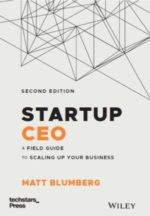
Now, over 700 blog posts later, I’m excited to announce that I’m writing a book based on this blog called Startup CEO: A Field Guide to Building and Running Your Company. The book is going to be published by Wiley & Sons and is due out next summer. The book won’t just be a compendium of blog posts, but it will build on a number of the themes and topics I’ve written about over the years and also fill in lots of other topics where I haven’t.
The catalyst for writing this book was Brad Feld. Brad has been a friend, mentor, investor, and Board member for over a decade. We’ve had many great times, meals, and conversations together over the years, not the least of which was staggering across the finish line together at the New York City Marathon in 2005. Brad started writing books a few years ago, and I’ve been peripherally involved with them, first with Do More Faster: TechStars Lessons to Accelerate Your Startup (I contributed one of the chapters) and then with Venture Deals: Be Smarter Than Your Lawyer and Venture Capitalist (I wrote all the “Entrepreneur Perspective” sidebars).
Those are great books, and they’ve been incredibly well received by the global entrepreneurial community. But then Brad got the bug, and now he’s in the middle of writing FOUR new books with Wiley that will all come out over the next year. They are:
- Startup Communities: Building an Entrepreneurial Ecosystem in Your City
- Startup Life: Surviving and Thriving in a Relationship with an Entrepreneur
- Startup Metrics: Making Sense of the Numbers in Your Startup
- Startup Boards: Reinventing the Board of Directors to Better Support the Entrepreneur
These four books, plus the two earlier ones, plus Startup CEO, are all part of the Startup Revolution series. While I’ll continue to do most of my blogging and posting here on OnlyOnce, I’d also encourage you to check out the Startup Revolution site and sign up to be a member of that community. I’ll be doing some things on that site as well in connection with Startup CEO, and it’s a more concentrated place to post and comment on all things Startup. In addition, we’ll be putting a bunch of add-ons to the book on that site closer to publication time.
I hope Startup CEO becomes a standard for all new CEOs. I don’t think I have all the answers, but at least others can benefit by learning from my 13 years of successes and mistakes! Now all I have to do is go write the darned thing.