
American Entrepreneurs
Fred beat me to it. I wasn’t at a computer to post this yesterday on the actual 4th of July, so today will have to do. I’ve read lots of books on the American revolution and the founding fathers over the years. It’s absolutely my favorite historical period, probably because it appeals to the entrepreneur in me. Think about what our founding fathers accomplished:
– Articulated a compelling vision for a better future with home democratic rule and capitalist principles. Life, liberty, and the pursuit of happiness is really the ultimate tag line when you think about it.
– Raised strategic debt financing from, and built critical strategic alliances with France, the Netherlands, and Spain.
– Assembled a team of A players to lead the effort in Washington, Adams, Jefferson, Franklin, Hamilton, and numerous others who haven’t been afforded the same level of historical stature.
– Built early prototypes to prove the model of democratic home rule in the form of most of the 13 colonial assemblies, the Committees of Correspondence, and the Articles of Confederation.
– Relentlessly executed their plans until they were successful, changing tactics several times over the years of 1774-1783 but never wavering from their commitment to the ultimate vision.
– Followed through on their commitments by establishing a new nation along the principles to which they publicly committed early on, and taking it to the next level with the Constitution and our current form of government in 1789.
And let’s not forget, these guys accomplished all of this at a time when it took several days to get a letter from Virginia to Boston on horseback and six weeks to get a message across the Atlantic on a sailboat. Can you imagine what Washington would have been able to accomplish if he could have IMd with Adams in Paris?
So happy 4th to all, with a big thanks to this country’s founding fathers for pulling off the greatest spin-off of all time.
Everyone’s a Marketer, Part II
Everyone’s a Marketer, Part II
In Part I of this posting, I talked about how everyone’s job function is increasingly touching customers and therefore, in our networked world, everyone needs to think like a marketer. This posting has the same theme but a different spin. From the perspective of the individual person (in a company, and in life), marketing is central to success, although the definition of your target market needs to change with the circumstances.
Interviewing for a job? How good a job have you done building the brand of you (your list of accomplishments)? How good is your collateral (resume)?
Want to get an increase in your department’s budget or buy a new piece of hardware? Have you adequately defined the return on the incremental investment you’re proposing?
Need to get that project done? What’s your universal selling proposition to get others to help you out (“here’s why it’s good for you to cooperate”)? Are there any incentives involved (“I’ll buy dinner if you stay late and help with this”)?
Working hard to get a promotion? Identify a new customer segment, or a new problem to solve for your customers, or a solution to that problem, and your marketing skills will get you there.
Want to go somewhere off the beaten path on vacation? Better come up with some great selling points that resonate with specific members of your family (it’s beautiful, it’s inexpensive, the food is great, no one else has ever been there) to convince them all to go along with you!
I suppose this posting (and maybe the other one as well) could be entitled “Everyone’s in Sales,” and that would also be fitting. Anyone who’s not in marketing or sales but who’s interested in learning a few of the basics should consider some outside reading. I’d recommend Positioning: The Battle for Your Mind, SPIN Selling, and Getting To Yes, but there are many, many other great books that would also do the job.
Blogiversary
Blogiversary
Next week will mark the one year anniversary of my blog (and for that matter, Brad’s blog). It’s been a lot of fun, so I think I’ll celebrate by taking two weeks off and going to Europe with Mariquita (well, ok, I was planning on doing that anyway).
Even if no one read OnlyOnce, I’d be happy I’m writing it for all of the reasons I expressed here back in June. But lots of people do read it, more and more every day. In fact, an executive at Yahoo! who I met earlier this week actually quoted it to me — as Bruno Kirby said in When Harry Met Sally, “the first time someone has ever quoted me back to me before.”
In my very first posting, which explains the blog’s title and mission, I said I’d try not to be too extraneous with the material I post. So I took a look through some stats this morning about the last year of blogging:
– Including this, I’ve written 131 postings, about one every three days
– Typepad doesn’t keep stats on blog topics/categories, so this is an estimate (and postings can be associated with multiple categories), but it looks like I’ve posted 6 times about books, 10 times about current events, 4 times about travel, 7 times about blogs, 9 times about “business” (whatever that means), 52 times about email/web/tech, 40 times about entrepreneurship, and 38 times about leadership/management. So at least I stayed more or less on point.
– I’ve received a total of 125 comments, or less than one per posting (this is NOT a truly interactive medium!)
– I have about 1,000 regular readers, roughly 70% via RSS feed, 20% via email subscription, and 10% via live alerts or just regular web visitors
– My Amazon Associates link has generated about 150 sales for a total of $2,700 and about $170 in affiliate fees to me, which basically covers the cost of my Typepad subscription
Thanks to everyone who reads and comments. Feedback is always welcome for year two!
A Ball Bearing in the Wheels of E-Commerce
A Ball Bearing in the Wheels of E-Commerce
As an online marketing professional, I’ve long understood intellectually how e-commerce works, how affiliate networks function, and why the internet is such a powerful selling tool. But I got an email the other day that drove this home more directly.
When I started my blog about a year and a half ago, I set myself up as an Amazon affiliate, meaning that any time someone clicks on a link to Amazon from one of my postings or on the blog sidebar, I get paid a roughly 4% commission on anything that person buys on Amazon on that session.
According to the email report I just got from Amazon on Q2 sales driven by my blog, I am responsible for driving traffic that buys about $2,500 worth of merchandise from Amazon every quarter, which yields about $100 to me in affiliate fees. All I really link to are business books that I summarize in postings, although people who click from my blog to Amazon end up buying all sorts of random things (according to my report, last quarter’s purchases included a Kathy Smith workout DVD and a new socket wrench set in addition to lots of copies of Jim Collins’ Built to Last and Malcolm Gladwell’s Blink.
This is a true win-win-win — Amazon gets traffic for a mere 4% of sales, a relatively low marketing cost; I get a small amount of money to cover the various fees associated with my blog (Typepad, Newsgator, Feedburner), and people who read my blog pay what they’re going to pay to Amazon anyway – and maybe get something they otherwise wouldn’t have gone out to get in the process.
My blog is certainly not a top 1,000 blog, or probably not even a top 10,000 blog in terms of size of audience. This is merely a microcosm that proves the macro trends. If I’m driving $10,000 per year of business to Amazon, now I REALLY understand how there are now approximately 500,000 people who make their LIVING by selling goods on eBay, and how probably another 500,000 people are making good side money or possibly even making their living by running offers and affiliate marketing programs from their web sites. I’m like a little ball bearing in the finely tuned but explosively growing wheel of e-commerce.
If my quarterly affiliate fees keep growing, I’ll find something more productive or charitable to do with them than keep them for myself. But for now, I am covering my costs and marveling on a personal level at how all this stuff works as well as it does.
Reality Bites
Reality Bites
So Oracle is buying the $1.5 billion revenue Siebel for $5.85 billion, and eBay is buying the at most $60 million revenue Skype for $2.4 billion, which could grow to $4.1 billion if Skype hits some performance targets. Huh. Must be all those pesky customers, receivables, and assets bogging down Siebel’s books.
UPDATE: Fortune’s David Kirkpatrick, one of the most insightful journalists covering technology, makes some sense of this in this week’s Fast Forward column.
Beyond CAN-SPAM: The Nightmare Continues, Part II
Beyond CAN-SPAM: The Nightmare Continues, Part II
A couple of months ago, I blogged about two well-intentioned but very unfortunate new laws on the books, one in Michigan and one in Utah, designed to protect children from advertising that’s harmful to minors, but in fact full of unintended consequences.
Today, the Detroit Free Press had a great article about how the law in Michigan is so poorly conceived and executed, that not only is it angering legitimate businesses, it’s actually angering the parents who were supposed to be its principle beneficiaries. One parent’s quote in the article pretty much sums it up:
“What was the whole point in signing up if it’s not doing any good? Is this just the legislature and the governor trying to look good and tough, but in the end, just kicking up dust?”
Agreed, and well said!
Managing in a Downturn
Managing in a Downturn
I spoke at a NextNY event last night along with several others, including fellow entrepreneur David Kidder from Clickable and angel investor Roger Enhrenberg about this fine topic (Roger wrote a great post on it here) and thought I’d share a few of the key points made by all of us for anyone trying to figure out what to do tactically now that Sequoia has told us to be afraid, very afraid.
Hope is Not a Strategy: Your business is not immune. It will do what everyone else’s will. Struggle to hit its numbers. Struggle to collect bills. Lose customers. There is no reason to hope you’ll be different.
Get Into the Jet Stream: Develop your core revenue streams — and make sure they’re really your revenue, not just skimming tertiary revenue out of the ecosystem. Investors will look to see how sustainable your model is with more scrutiny than ever.
It’s a Long Road to Recovery: I don’t care what people say. There is no true “v-shaped” bounceback from a true downturn. Plan for a long (4-8 quarter) time to return to normalcy.
Budget Early and Often: Things change rapidly in this kind of environment. Make sure you reforecast, especially cash flows and cash, monthly when you close the books.
Don’t Stop Thinking About Tomorrow: If you have a real business, you need to be it for the long haul. Keep pursuing opportunities. Keep investing in the future. Don’t pare back your vision and ambitions. Just make more conservative investments, insist on shorter payback windows, and adjust expectations about timeframes.
Leadership Counts: Your people are nervous. They’re concerned about their own bank accounts. Their jobs. Be even more present, more transparent, and more communicative. And set the right tone on expenses with your own decisions. The troops need to know that you care about them — and that the big boss has a steady hand on the wheel.
Hackoff – The Blook, Part II
Hackoff – The Blook, Part II
A few weeks back, I posted about a new blook (book delivered in single episodes via blog) called Hackoff.com – An Historic Murder Mystery Set in the Internet Bubble and Rubble, by Tom Evslin. A few weeks into it, and I’m hooked. It’s:
– complete and total brain candy, or mental floss as Brad calls it
– a great 2 minute break in the middle of the day (episodes are delivered once a day during the week)
– a very entertaining reminder about some of the wacky things that went on back in the Internet heyday
– a good look into some of the processes that go on behind the scenes in taking a company public
If you haven’t started the blook yet and want to give it a try, you can catch up on all of the first episodes and subscribe to the new ones here. You can also preorder a hardcover copy of the book here on Amazon.com.
Environmentally Unsound
I received in the mail yesterday (by overnight priority mail, no less), a 400+ page prospectus from Mittal, a Dutch company in which I apparently own a few shares of stock through a managed mutual fund I’m part of. This book was BIG – well over 2 inches thick and big enough to have a binding strip instead of staples. And it had enough legalese in it to put anyone to sleep.
What did I do with it? After ranting about how silly it was to ever print such a thing for mass push distribution to an audience that largely doesn’t care about it — straight into the trash. With a big thud, of course.
What a ridiculous waste. Why print it on paper at all? Make it available online via pdf. Email shareholders or send them a postcard or leave an automated voicemail and ask them if they want a hard copy. Figure out which shareholders are in a managed fund, and send a single copy to the fund manager, since the individuals don’t even know they’re shareholders or don’t make decisions about individual stocks in the fund. Do something that costs less and doesn’t destroy trees that 99% of people will never read.
Shame on Mittal and their bankers, proudly displayed on the cover of the book — Goldman Sachs, Citigroup Credit Suisse, HSBC and Societe General.
Counter Cliche: Ready, Set, Exit
Counter Cliche: Ready, Set, Exit
Fred’s VC Cliche of the week is the about the Quick Flip. My counter to that is Ready, Set, Exit (image from Google Images).
Most quick flips involve a huge element of luck. For every quick flip out there, there are dozens of companies that thought they’d be quick flips and ended up crashing and burning instead. Back in 1999, when we started Return Path, another Internet entrepreneur I knew loved the idea so much that he told me to start writing the book then, because I would be able to sell the for $100 million before we even had a product in the market. He said the title of the book would be Ready, Set, Exit.
We were careful not to behave that way, and that’s one of the reasons we’re still here and doing as well as we are doing today.
As nice as it is to be an investor or an entrepreneur who falls into a Quick Flip scenario, beware of anyone who’s planning on Ready, Set, Exit, whether you’re being pitched to invest, to join the company, or even to be a customer. Ready, Set, Exit scenarios can’t be manufactured or counted on (if they could, everyone would do them), and that whole mentality is completely antithetical to the stamina required to build a real company.
I think it’s analogous to what everyone tells you when you’re in junior high or high school: you’ll never find a girlfriend/boyfriend if you’re out looking for one.

StartupCEO.com: A New Name for OnlyOnce
Welcome to the new StartupCEO.com!
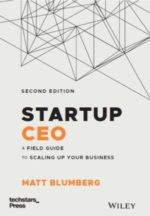
I started writing this blog in May of 2004 with an objective of writing about the experience of being a first-time entrepreneur — a startup CEO — inspired by a blog post written by my friend, long-time Board member and mentor Fred Wilson entitled “You’re only a first time CEO once.” The blog and the receptivity I got along the way from fellow startup CEOs encouraged me to write a book called Startup CEO: A Field Guide to Scaling Up Your Business, which was originally published in 2013 and then again as a second edition last year in 2020.
Today I am relaunching the blog as StartupCEO.com both to reflect that relevance of that brand as the book continues to get good traction in the startup ecosystem, and to reflect the fact that I’m now on my second startup as CEO, so “Only Once” doesn’t seem so fitting any more.
The web site has a very minimalist design – and I realize many of you read posts on either RSS or email — those will still operate the same as they have been (no new RSS feed).
As I approach the first anniversary of starting our new company, Bolster, where we help startup CEOs scale their teams, themselves, and their boards, I am recommitting to this blog and will try to post at least once a week. Because there is a lot of overlap between this blog and Bolster’s blog (which I’d encourage you to subscribe to here either by email or RSS), posts will occasionally show up on both blogs, or I’ll put digests of Bolster blog posts here.
But the Bolster blog will be broader and will also have many additional authors besides me, while this blog will remain distinct about some of the experiences I’m having as a startup CEO.