

Startup Boards, the book, and also why they matter more than ever these days
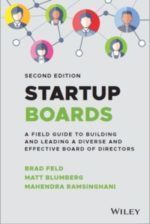
My latest book (I’m a co-author along with Brad Feld and Mahendra Ramsinghani), Startup Boards: A Field Guide to Building and Leading an Effective Board of Directors, is now live on Amazon – today is publication day! The book is a major refresh of the first edition, now eight years old. I was quoted in it extensively but not an official author – Brad and Mahendra were nice enough to share that with me this time. The book includes a lot of new material and new voices, including a great Foreword by Jocelyn Mangan from Him for Her and Illumyn. It’s aligned with Startup CEO and Startup CXO in look and in format and is designed to be an easy-to-read operator’s manual to private company boards of directors. Brad also blogged about it here.
We’ve done a lot of work around startup boards at Bolster the past couple of years, including working with over 30 CEOs to help them hire amazing new independent board members. Our landmark Board Benchmark study last year highlighted the problem with startup boards, but also the opportunity that lies within: not enough diversity on the boards, but also not nearly enough independent directors — and a lot of open seats for independent directors that could be filled. That conclusion led me to my Startup Board Mantra of 1-1-1: Independent directors from Day 1, 1 member of the management team, and 1 independent for every 1 investor.
As we posted on the Bolster blog last week, our quick refresh of the Board Benchmark study revealed some good news and some bad news about progress on diversity in the boardroom with startups. The good news is that the needle is starting to move very slowly, and that independent directors present the best opportunity to add diversity to boards. Our data shows that half of all new directors brought onto boards in the last year were independents, and of those, 57.9% were women and 31.6% were non-White board members. Those numbers are well above the prior study’s benchmarks of 36% and 23%, respectively (our experience running board searches skews even further to women and non-White directors being hired).
The bad news is how slowly the needle is moving — only 20% of open independent board seats were filled over the previous year, which is a lot of missed opportunity. The main takeaway is that while overall representation on boards is still skewed largely White and male, the demographic profile of new board appointments looks a lot different from the representation on boards today, indicating that CEOs are making intentional changes to their board composition.
Startup boards are a great way to drive grassroots change to the face of leadership in corporate America. More CEOs need to follow up by filling their open board seats and fulfilling their stated desires to improve diversity in the boardroom. This takes time and prioritization — these are the places where we see board searches either never get off the ground, or falling down once they do, for all the searches we either run or pitch at Bolster.
Hopefully Startup Boards will help the startup ecosystem get there.
Don’t Confuse Sucking Down with Servant Leadership
I love the concept of Servant Leadership. From the source, the definition is:
While servant leadership is a timeless concept, the phrase “servant leadership” was coined by Robert K. Greenleaf in The Servant as Leader, an essay that he first published in 1970. In that essay, Greenleaf said:
“The servant-leader is servant first… It begins with the natural feeling that one wants to serve, to serve first. Then conscious choice brings one to aspire to lead. That person is sharply different from one who is leader first, perhaps because of the need to assuage an unusual power drive or to acquire material possessions…The leader-first and the servant-first are two extreme types. Between them there are shadings and blends that are part of the infinite variety of human nature.
“The difference manifests itself in the care taken by the servant-first to make sure that other people’s highest priority needs are being served. The best test, and difficult to administer, is: Do those served grow as persons? Do they, while being served, become healthier, wiser, freer, more autonomous, more likely themselves to become servants? And, what is the effect on the least privileged in society? Will they benefit or at least not be further deprived?“
A servant-leader focuses primarily on the growth and well-being of people and the communities to which they belong. While traditional leadership generally involves the accumulation and exercise of power by one at the “top of the pyramid,” servant leadership is different. The servant-leader shares power, puts the needs of others first and helps people develop and perform as highly as possible.
This is a very broad societal definition, but it’s fairly easy to apply to a more narrow corporate, or even startup environment. Are you as a CEO oriented primarily towards your people, or towards other stakeholders like customers or shareholders? By the way, trying to do right by all three stakeholders is NOT a problem in a world of being oriented towards one. It’s just a philosophy around which comes first, and why. Our People First philosophy at Return Path is fair clear that at the end of the day, all three stakeholders win IF you do right by employees, so they do the best possible work for customers, so you build a healthy and profitable and growing business.
CEOs who practice Servant Leadership aren’t necessarily focused on power dynamics, or on helping those least privileged in society (at least not as part of their job)…but they are focused on making sure that their employees most important needs are met — both in the moment, as in making sure employees are empowered and not blocked or bottlenecked, and over the long haul, as in making sure employees have opportunities to learn, grow, advance their careers, make an impact, and have the ability to live a well balanced life.
I was in a meeting a couple weeks back with another leader and a few people on his team. He *seemed* to practice Servant Leadership the way he was speaking to his team members. But he wasn’t, really. He was doing something I refer to as Sucking Down. He was telling them things they clearly wanted to hear. He was lavishing praise on them for minor accomplishments. He was smiling and saying yes, when what he really meant was no. He was practicing the art of Sucking Up, only to people on his team, not to a boss. I got a sense that something wasn’t right during the meeting, and then post meeting, he actually fessed up to me — even bragged about it — that he was being disingenuous to get what he wanted out of his people.
There’s a clear difference between Servant Leadership and Sucking Down in the long run. The danger comes in the moment. Just as managers need to build good detection skills to sniff out evidence of someone on their team Sucking Up, employees need to be able to understand that clear difference in their managers’ behavior as they think about how to manage their careers, and even where to work.
Political versus Corporate Leadership, Part I: Realist or Idealist?
It’s election season, the GOP convention is literally in my backyard, and while this is not a political blog, I can’t help myself. As we as Americans grapple with the question of who we want to be our next leader (or at least those people who live in the 11 annointed swing states do), I have had a lot of thoughts lately about the question of what makes a good leader, and what the differences are between successful leadership in politics and successful leadership in business.
James O’Toole’s article on President Bush on page 31 of the September issue of Fast Company (no link available yet) brings up a really interesting point in comparing Bush to former president Ronald Reagan. He asserts that “what made Reagan effective and respected was that his actions followed consistently from a positive worldview.” (I’d also argue that the positive worldview as a starting point had something to do with it, but that’s beside the point.) He goes on to say that Bush has an “implementation problem” in that he “has vacillated between contradictory approaches to leadership: realism and idealism.” His central thesis is stated very clearly that
“Realists and idealists can both be effective leaders. But one cannot be both at once…The leadership lesson for GW – and for any leader – is simple: Followers don’t much care if leaders are realists or idealists, but they distrust inconsistency.”
This may or may not be true in the political arena, but I know it’s not true in business. Jim Collins’ watershed books Built to Last and Good to Great — both must reads! — describe the ideal CEO as someone who can simultaneously be optimistic and idealistic about the future of the company while simultaneously recognizing and dealing with the realities of the short-term situation. Ironically for this posting, Collins calls this the Stockdale paradox, after retired Admiral James Stockdale, a military leader and erstwhile vice presidential candidate of Ross Perot in the 1992 election.
As CEO, I have to constantly be selling the vision of the company — what we’re trying to become and how we’re going to get there — in broad strokes to my investors, board, management team, employees, and even customers. It’s that vision that keeps the whole machine running and keeps everyone focused and excited and working hard towards our long-term goals. But I have to be equally vigilant about the mundane realities of the current quarter, making our numbers, containing costs, and running the machine. If I did either one without the other, I think the whole system would break down.
Is Bush’s problem, as O’Toole asserts, that he articulated two different types of reasons for the war in Iraq — one rooted in Realism (WMD) and one rooted in Idealism (freedom and democracy)? Same goes for his states reasons for the tax cut — Realism on the one hand (to stimulate the economy) and Idealism on the other hand (shrink government). I agree that the Bush Administration has occasional implementation problems and doesn’t have nearly the “following” that Reagan and other more successful leaders in the past have, but I don’t think they’re caused by combining Realism and Idealism in the President’s leadership style. I think the leader of the free world has to do both well, each at its appropriate time, in order to be effective at his job.
Next up in this series: Admitting Mistakes.
Book Short: A Twofer
Book Short: A Twofer
My friend Andrew Winston, who is one of the nation’s gurus in corporate sustainability, just published his second book, this one from Harvard Business Press — Green Recovery: Get Lean, Get Smart, and Emerge from the Downturn on Top. It builds on the cases and successes he had with his first book, Green to Gold (post, link to book), which came out a couple years ago and has become the standard for how businesses embrace sustainability and use it to their financial and strategic competitive advantage rather than thinking of it as a burden or a cost center.
Green Recovery is a shorter read (my kind of business book), and it hits a few key themes:
-
Going green not only shouldn’t wait for better economic times, it’s a key way out of this mess
- Businesses have relied on layoffs to cut costs for far too long — it’s time to get lean on stuff, not people
- This is about survival for many businesses: Detroit died because it missed the green wave of environmental interest and rising energy prices
- And the overarching theme…Green doesn’t raise costs, it lowers them – it’s a source of profit and innovation
The book reminds me a lot of my post Living With Less, For Good, which I wrote at the beginning of the financial market freefall last fall, talking about how we as a company were figuring out how to cut back without cutting people (something we’ve managed to do). Although I wasn’t talking about green initiatives specifically, the point of getting leaner on “stuff” really resonates with me.
At the end of the day, Andrew proves that steering your company to go green — no matter what industry you’re in — is a twofer: you can increase the strength of the business and simultaneously do your part to clean up the environment. That’s definitely the “change we can believe in” mentality applied quite pragmatically!
Book Short: You’d Never Run Your Business This Way…
Book Short: You’d Never Run Your Business This Way…
I am an unabashed conservative, so you might wonder what I was doing reading A Country That Works, by union chief Andy Stern, the President of SEIU (Service Workers International Union) this weekend. Well, part of it is that my mother-in-law Carmen works for him. Part was that he was quite inspiring during his recent appearance on the Colbert Report a week or two ago. And part was that I always like reading about different points of view, especially with the current, somewhat dismal state of the Republican leadership in Washington.
The book was very short and a worthwhile read. I may not agree with Stern on some of his illustrations of the problems — his statistical presentations were a bit apples-to-oranges at times — and some of his solutions, which were a bit high on the big-government-tax-and-spend side for me, but the book was very plain-speak, apolitical, and solution-oriented, all of which I found refreshing.
He certainly had at least one underlying premise about “labor as electricity ” (compete on something else other than forcing wages to go lower) that is making me think hard about my long-standing philosophical opposition to federally-mandated minimum wages. His notion of the importance of a global labor movement to act as a check/balance on corporate globalization both make sense. Actually, now that I think about it, those two things put together start working well as one plank in a solution to global poverty.
But the best part of the book was the fact that Stern is clear that, like his ideas or hate them, he is at least proposing that we DEAL with them. America is missing serious debate about some critical issues facing our society. Anyone who doesn’t think we have serious problems facing our future around retirement savings, education, and health care is not facing reality. The debate happening in Washington today is weak at best, and over-politicized.
The bottom line is that I think we’re in danger as a country of boiling the frog when it comes to some major structural issues in our society, and, most important to me, You’d Never Run Your Business This Way. Any good entrepreneur knows that when danger lurks around the corner, you have to reinvent yourself, and we as a country aren’t doing that at this moment when we’d benefit from it greatly for the long term. Stern displays that mix of optimism for the future and serious reality check today known as the Stockdale Paradox and revered by Jim Collins in his two books on corporate leadership, Good to Great and Built to Last.
My biggest criticism of the book was that it was too short. It was basically 1/3 Andy’s story, 1/3 SEIU’s story, and 1/3 labor’s story — and it could have been at least twice as long and gone into more detail on Stern’s points, especially in the last chapter where he starts spelling out his plan to get America back on track. But presumably when Stern runs for national office or gets a cabinet appointment someday (no inside knowledge here, but the book certainly reads that way), he’ll flesh things out a bit!
The Gift of Feedback, Part III
The Gift of Feedback, Part III
I’ve written about our 360 Review process at Return Path a few times in the past:
- overall process
- process for my review in particular
- update on a process change and unintended consequences of that process change)
- learnings from this year’s process about my staff
And the last two times around, I’ve also posted the output of my own review publicly here in the form of my development plan:
So here we are again. I have my new development plan all spruced up and ready to go. Many thanks to my team and Board for this valuable input, and to Angela Baldonero (my fantastic SVP People and in-house coach), and Marc Maltz of Triad Consulting for helping me interpret the data and draft this plan. Here at a high level is what I’m going to be working on for the next 1-2 years:
- Institutionalize impatience and lessen the dependency dynamic on me. What does this mean? Basically it means that I want to make others in the organization and on my team in particular as impatient as I am for progress, success, reinvention, streamlining and overcoming/minimizing operational realities. I’ll talk more about something I’ve taken to calling “productive disruption” in a future blog post
- Focus on making every staff interaction at all levels a coaching session. Despite some efforts over the years, I still feel like I talk too much when I interact with people in the organization on a 1:1 or small group basis. I should be asking many more questions and teaching people to fish, not fishing for them
- Continue to foster deep and sustained engagement at all levels. We’ve done a lot of this, really well, over the years. But at nearly 250 people now and growing rapidly, it’s getting harder and harder. I want to focus some real time and energy in the months to come on making sure we keep this critical element of our culture vibrant at our new size and stage
- I have some other more tactical goals as well like improving at public speaking and getting more involved with leadership recruiting and management training, but the above items are more or less the nub of it
One thing I know I’ll have to do with some of these items and some of the tactical ones in particular is engage in some form of deliberate practice, as defined by Geoffrey Colvin in his book Talent is Overrated (blog post on the book here). That will be interesting to figure out.
But that’s the story. Everyone at Return Path and on my Board – please help me meet these important goals for my development over the next couple of years!
Book Short: Crazy Eights
Book Short: Crazy Eights
In honor of Return Path being in the midst of its eighth year, I recently read a pair of books with 8 in the title (ok, I would have read them anyway, but that made for a convenient criterion when selecting out of my very large “to read” pile).
Ram Charan’s latest, Know-How: The 8 Skills That Separate People People Who Perform From Those Who Don’t, was pretty good and classic Charan. Quick, easy to skim and still get the main points. The book lost a little credibility with me when Charan lionized Verizon (perhaps he uses a different carrier himself) and Bob Nardelli (the book was published before Nardelli’s high profile dismissal), but makes good points nonetheless. Some of the 8 Skills he talks about are what you’d expect on the soft side of leadership — building the team, understanding the social system, judging people — but his best examples were particularly actionable around positioning, goal setting, and setting priorities. The book reminded me much more of Execution and much less of Confronting Reality (which is a good thing).
For years I’ve felt like the last person around to still not have read The 7 Habits of Highly Effective People, so I thought I’d skip straight to the punchline and read Stephen Covey’s newer book, The 8th Habit: From Effectiveness to Greatness. Fortunately, as I’d hoped, the new book summarizes the prior book several times over, so if you haven’t read the first, you could certainly just start with this one. The book also comes with a DVD of 16 short films, some of which are great — both inspirational and poignant. Unlike most business books, the 8th Habit is NOT skimmable. It almost has too much material in it and could probably be read multiple times or at least in smaller pieces. The actual 8th habit Covey talks about is what he calls Find Your Voice and Help Others Find Their Voices and is a great encapsulation of what leading a knowledge worker business is all about. But the book is much deeper and richer than that in its many models and frameworks and examples/tie-ins to business and goes beyond the “touchy feely” into hard-nosed topics around execution and strategy.
Now I’m looking for the DVD of the first season of Eight is Enough!
Book Short: Chip Off the Old Block
Book Short: Chip Off the Old Block
I have to admit, I was more than a little skeptical when Craig Spiezle handed me a copy of The Speed of Trust, by Stephen M. R. Covey, at the OTA summit last week. The author is the son of THE Stephen Covey, author of the world famous Seven Habits of Highly Effective People as well as The Eighth Habit (book, post). Would the book have substance and merit or be drafting off the dad’s good name?
I dog-ear pages of books as I read them, noting the pages that are most interesting if I ever want to go back and take a quick pass through the book to remind me about it (and yes, Ezra, I can do this on the Kindle as well via the bookmark feature). If dog-ear quantity is a mark of how impactful a book is, The Speed of Trust is towards the top of the list for me.
The book builds nicely on Seven Habits and The Eighth Habit and almost reads like the work of Stephen the father. The meat of the book is divided into two sections: one on developing what Covey calls “self trust,” a concept not unlike what I blogged about a few months ago, that if you make and keep commitments to yourself, you build a level of self-confidence and discipline that translates directly into better work and a better mental state. The other core section is one on building trust in relationships, where Covey lists out 13 behaviors that all lead to the development of trust.
In fact, we just had a medium-size trust breach a couple weeks ago with one of our key clients. Reading the book just as we are struggling to “right the wrong” was particularly impactful to me and gave me a number of good ideas for how to move past the issue without simply relying on self-flagellation and blunt apologies. This is a book full of practical applications.
It’s not a perfect book (no book is), and in particular its notion of societal trust through contribution is a bit weak relative to the rest of the book, but The Speed of Trust is an excellent read for anyone who wants to understand the fastest way to build — and destroy — a winning culture. It reads like a sequel of Covey senior’s books, but that’s a good thing.
Book Short: I Wish This Existed 12 Years Ago
Book Short: I Wish This Existed 12 Years Ago
Brad Feld has been on my board for over a decade now, and when he and his partner Jason Mendelson told me about a new book they were writing a bunch of months ago called Venture Deals: Be Smarter Than Your Lawyer and Venture Capitalist, I took note. I thought, “Hmmm. I’d like to be smarter than my lawyer or venture capitalist.”
Then I read an advanced copy. I loved it. At first, I thought, I would really have benefited from this when I started Return Path way back when. Then as I finished reading it, I realized it’s just a great reference book even now, all these years and financings later. But as much as I enjoyed the early read, I felt like something was missing from the book, since its intended audience is entrepreneurs.
Brad and Jason took me up on my offer to participate in the book’s content a little bit, and they are including in the book a series of 50-75 sidebars called “The Entrepreneur’s Perspective” which I wrote and which they and others edited. For almost every topic and sub-topic in the book, I chime in, either building on, or disagreeing, with Brad and Jason’s view on the subject.
The book is now out. As Brad noted in his launch post, the book’s table of contents says a lot:
- The Players
- How to Raise Money
- Overview of the Term Sheet
- Economic Terms of the Term Sheet
- Control Terms of the Term Sheet
- Other Terms of the Term Sheet
- The Capitalization Table
- How Venture Capital Funds Work
- Negotiation Tactics
- Raising Money the Right Way
- Issues at Different Financing States
- Letters of Intent – The Other Term Sheet
- Legal Things Every Entrepreneur Should Know
Fred has posted his review of the book as well.
Bottom line: if you are an aspiring or actual entrepreneur, buy this book. Even if you’ve done a couple of financings, this is fantastic reference material, and Brad and Jason’s points of view on things are incredibly insightful beyond the facts. And I hope my small contributions to the book are useful for entrepreneurs as well.
Half the Benefit is in the Preparation
Half the Benefit is in the Preparation
This past week, we had what has become an annual tradition for us – a two-day Board meeting that’s Board and senior management (usually offsite, not this year to keep costs down) and geared to recapping the prior year and planning out 2009 together. Since we are now two companies, we did two of them back-to-back, one for Authentic Response and the other for Return Path.
It’s a little exhausting to do these meetings, and it’s exhausting to attend them, but they’re well worth it. The intensity of the sessions, discussion, and even social time in between meetings is great for everyone to get on the same page and remember what’s working, what’s not, and what the world around us looks like as we dive off the high dive for another year.
The most exhausting part is probably the preparation for the meetings. We probably send out over 400 pages of material in advance – binders, tabs, the works. It’s the only eco-unfriendly Board packet of the year. It feels like the old days in management consulting. It takes days of intense preparation — meetings, spreadsheets, powerpoints, occasionally even some soul searching — to get the books right. And then, once those are out (the week before the meeting), we spend almost as much time getting the presentations down for the actual meeting, since presenting 400 pages of material that people have already read is completely useless.
By the end of the meetings, we’re in good shape for the next year. But before the meetings have even started, we’ve gotten a huge percentage of the benefit out of the process. Pulling materials together is one thing, but figuring out how to craft the overall story (then each piece of it in 10-15 minutes or less) for a semi-external audience is something entirely different. That’s where the rubber meets the road and where good executives are able to step back; remember what the core drivers and critical success factors are; separate the laundry list of tactics from the kernel that includes strategy, development of competitive advantage, and value creation; and then articulate it quickly, crisply, and convincingly.
I’m incredibly proud of how both management teams drove the process this year – and I’m charged up for a great 2009 (economy be damned!).
Book Short: A Marketing-Led Turnaround
Book Short: A Marketing-Led Turnaround
Generally, I love books by practitioners even more than those by academics. That’s why Steve McKee’s first (I assume) book, When Growth Stalls: How it Happens, Why You’re Stuck, and What to do About It (book, Kindle edition) appealed to me right out of the gate. The author is CEO of a mid-size agency and a prior Inc. 500 winner who has experienced the problem firsthand – then went out, researched it, and wrote about it. As a two-time Inc. 500 winner ourselves, Return Path has also struggled with keeping the growth flames burning over the years, so I was eager to dig into the research. The title also grabbed my attention, as there are few if any business books really geared at growth stage companies.
I’d say the book was “solid” in the end, not spectacular. Overall, it felt very consistent with a lot of other business books I’ve read over the years, from Trout & Reis to Lencioni to Collins, which is good. The first half of the book, describing the reasons why growth stalls, was quite good and very multi-faceted. His labeling description of “market tectonics” is vivid and well done. He gets into management and leadership failings around both focus and consensus, all true. Perhaps his most poignant cause of stalls in growth is what he calls “loss of nerve,” which is a brilliant way of capturing the tendence of weak leadership when times get tough to play defense instead of offense.
The problem with the book in the end is that the second section, which is the “how to reverse the stall” section, is way too focused on marketing. That can be the problem with a specialty practitioner writing a general business book. What’s in the books makes a lot of sense about going back to ground zero on positioning, market and target customer definition and understanding, and the like. But reversing the stall of company can and usually must involve lots of the other same facets that are documented in the first half of the book — and some other things as well, like aggressive change management and internal communication, systems and process changes, financial work, etc.
At any rate, if you are in a company where growth is stalling, it’s certainly a good read and worth your time, as what’s in it is good (it’s what’s missing that tempers my enthusiasm for it). In this same category, I’d also strongly recommend Confidence: How Winning Streaks and Losing Streaks Begin and End, by Rosabeth Moss Kanter, as well.