Book Short: Vulnerability Applied to Leadership
Book Short: Vulnerability Applied to Leadership
Getting Naked: A Business Fable About Shedding The Three Fears That Sabotage Client Loyalty (book, Kindle), is Patrick Lencion’s latest fable-on-the-go book, and it’s as good a read as all of his books (see list of the ones I’ve read and reviewed at the end of the post).
The book talks about the power of vulnerability as a character trait for those who provide service to clients in that they are rewarded with levels of client loyalty and intimacy. Besides cringing as I remembered my own personal experience as an overpaid and underqualified 21 year old analyst at how ridiculous some aspects of the management consulting industry are…the book really made me think. The challenge to the conventional wisdom of “never letting ‘em see you sweat” (we *think* vulnerability will hurt success, we *confuse* competence with ego, etc.) is powerful. And although vulnerability is often uncomfortable, I believe Lencioni is 100% right – and more than he thinks.
First, the basic premise of the book is that consultants have three fears they need to overcome to achieve nirvana – those fears and the mitigation tactics are:
- Fear of losing the business: mitigate by always consulting instead of selling, giving away the business, telling the kind truth, and directly addressing elephants in the room
- Fear of being embarrassed: mitigate by asking dumb questions, making dumb suggestions, and celebrating your mistakes
- Fear of feeling inferior: mitigate by taking a bullet for the client, making everything about the client, honoring the client’s work, and doing your share of the dirty work
But to my point about Lencioni being more right than he thinks…I’d like to extend the premise around vulnerability as a key to success beyond the world of consulting and client service into the world of leadership. Think about some of the language above applied to leading an organization or a team:
- Telling the kind truth and directly addressing elephants in the room: If you’re not going to do this, who is? There is no place at the top of an organization or team for conflict avoidance
- Asking dumb questions: How else do you learn what’s going on in your organization? How else can you get people talking instead of listening?
- Making dumb suggestions: I’d refer to this more as “bringing an outside/higher level perspective to the dialog.” You never know when one of your seemingly dumb suggestions will connect the dots for your team in a way that they haven’t done yet on their own (e.g., the suggestions might not be so dumb after all)
- Celebrating your mistakes: We’re all human. And as a leader, some of your people may build you up in their mind beyond what’s real and reasonable. Set a good example by noting when you’re wrong, noting your learnings, and not making the same mistake twice
- Taking a bullet for your team, making everything about your team and honoring your team’s work: Management 101. Give credit out liberally. Take the blame for team failings.
- Doing your share of the dirty work: An underreported quality of good leaders. Change the big heavy bottle on the water cooler. Wipe down the coffee machine. Order the pizza or push the beer cart around yourself. Again, we’re all human, leaders aren’t above doing their share to keep the community of the organization safe, fun, clean, well fed, etc.
There’s a really powerful message here. I hope this review at least scratches the surface of it.
The full book series roundup as far as OnlyOnce has gotten so far is:
- The Three Signs of a Miserable Job (post, book)
- The Five Temptations of a CEO (post, book)
- The Four Obsessions of an Extraordinary Executive (post, book)
- Death by Meeting (post, book)
- The Five Dysfunctions of a Team (post, book, Field Guide)
- Silos, Politics and Turf Wars (post, book)
- Getting Naked (post, book)
Book Short: Awesome Title, So-So Book
Book Short: Awesome Title, So-So Book
Strategy and the Fat Smoker (book, Kindle), by David Maister, was a book that had me completely riveted in the first few chapters, then completely lost me for the rest. That was a shame. It might be worth reading it just for the beginning, though I’m not sure I can wholeheartedly recommend the purchase just for that.
The concept (as well as the title) is fantastic. As the author says in the first words of the introduction:
We often (or even usually) know what we should be doing in both personal and professional life. We also know why we should be doing it and (often) how to do it. Figuring all that out is not too difficult. What is very hard is actually doing what you know to be good for you in the long-run, in spite of short-run temptations. The same is true for organizations.
The diagnosis is clear, which is as true for organizations as it is for fat people, smokers, fat smokers, etc. The hard work (pain) is near-term, and the rewards (gain) are off in the future, without an obvious or visible correlation. As someone who has had major up and down swings in weight for decades, I totally relate to this.
But the concept that
the necessary outcome of strategic planning is not analytical insight but resolve,
while accurate, is the equivalent of an entire book dedicated to the principle of “oh just shut up and do it already.” The closest the author comes to answering the critical question of how to get “it” done is when he says
A large part of really bringing about strategic change is designing some new action or new system that visibly, inescapably, and irreversibly commits top management to the strategy.
Right. That’s the same thing as saying that in order to lose weight, not only do you need to go on a diet and weigh yourself once in a while, but you need to make some major public declaration and have other people help hold you accountable, if by no other means than causing you to be embarrassed if you fail in your quest.
So all that is true, but unfortunately, the last 80% of the book, while peppered with moderately useful insights on management and leadership, felt largely divorced from the topic. It all just left me wanting inspirational stories of organizations doing the equivalent of losing weight and quitting smoking before their heart attacks, frameworks of how to get there, and the like. But those were almost nonexistent. Maybe Strategy and the Fat Smoker works really well for consulting firms – that’s where a lot of the examples came from. I find frequently that books written by consultants are fitting for that industry but harder to extrapolate from there to any business.
Book short: Life Isn’t Just a Wiki
Book short: Life Isn’t Just a Wiki
One of the best things I can say about Remote: Office Not Required, by Jason Fried and David Heinemeier Hansson, is that it was short. That sounds a little harsh – part of what I mean is that business books are usually WAY TOO LONG to make their point, and this one was blessedly short. But the book was also a little bit of an angry rant against bad management wrapped inside some otherwise good points about remote management.
The book was a particularly interesting read juxtaposed against Simon Sinek’s Leaders Eat Last which I just finished recently and blogged about here, which stressed the importance of face-to-face and in-person contact in order for leaders to most effectively do their jobs and stay in touch with the needs of their organizations.
The authors of Remote, who run a relatively small (and really good) engineering-oriented company, have a bit of an extreme point of view that has worked really well for their company but which, at best, needs to be adapted for companies of other sizes, other employee types, and other cultures. That said, the flip side of their views, which is the “everyone must be at their cubicle from 9 to 5 each day,” is even dumber for most businesses these days. As usual with these things, the right answer is probably somewhere in between the extremes, and I was reminded of the African proverb, “If you want to go fast, go alone. If you want to go farm go together” when I read it. Different target outcomes, different paths.
I totally agree with the authors around their comments about trusting employees and “the work is what matters.” And we have a ton of flexibility in our work at Return Path. With 400 people in the company, I personally spend six weeks over the summer working largely remote, and I value that time quite a bit. But I couldn’t do it all the time. We humans learn from each other better and treat each other better when we look at each other face to face. That’s why, with the amount of remote work we do, we strongly encourage the use of any form of video conferencing at all times. The importance of what the authors dismiss as “the last 1 or 2% of high fidelity” quality to the conversation is critical. Being in person is not just about firing and hiring and occasional sync up, it’s about managing performance and building relationships.
Remote might have been better if the authors had stressed the value that they get out of their approach more than ranting against the approaches of others. While there are serious benefits of remote work in terms of cost and individual productivity (particularly in maker roles), there are serious penalties to too much of it as well in terms of travel, communication burden, misunderstandings, and isolation. It’s not for everyone.
Thanks to my colleague Hoon Park for recommending this to me. When I asked Hoon what his main takeaway from the book was, he replied:
The importance of open communication that is archived (thus searchable), accessible (transparent and open to others) and asynchronous (doesn’t require people to be in the same place or even the same “timespace”). I love the asynchronous communication that the teams in Austin have tried: chatrooms, email lists (that anyone can subscribe to or read the archives of), SaaS project management tools. Others I would love to try or take more advantage of include internal blogs (specifically the P2 and upcoming O2 WordPress themes; http://ma.tt/2009/05/how-p2-changed-automattic/), GitHub pull requests (even for non-code) and a simple wiki.
These are great points, and good examples of the kinds of systems and processes you need to have in place to facilitate high quality, high volume remote work.
Book Short: Alignment Well Defined
The Advantage: Why Organizational Health Trumps Everything Else In Business is Patrick Lencioni’s newest book. Unlike most or all of his other books (see the end of this post for the listing), this one is not a fable, although his writing style remains very quick and accessible.
I liked this book a lot. First, the beginning section is a bit of a recap of his Five Dysfunctions of a Team which I think was his best book. And the ending section is a recap of his Death by Meeting, another really good one. The middle sections of the book are just a great reminder of the basic building blocks of creating and communicating strategy and values – about driving alignment.
But the premise, as the subtitle indicates, is that maintaining organizational health is the most important thing you can do as a leader. I tell our team at Return Path all the time that our culture is a competitive advantage in many ways, some quantifiable, and others a little less tangible.
A telling point in the book is when Lencioni is relaying a conversation he had with the CEO of a client company who does run a healthy organization – he asked, “Why in the world don’t your competitors do any of this?” And the client responded, “You know, I honestly believe they think it’s beneath them.” Lencioni goes on to say, “In spite of its undeniable power, so many leaders struggle to embrace organizational health because they quietly believe they are too sophisticated, too busy, or too analytical to bother with it.” And there you have it. More examples of why “the soft stuff” is mission critical.
Lencioni’s “Recipe for Organizational Health” (the outline of the book):
– Build a Cohesive Leadership Team
– Create Clarity
– Overcommunicate Clarity
– Reinforce Clarity
And his recipe for creating a tight set of “mission/vision/values” (the middle of the book):
1. Why do we exist?
2. How do we behave?
3. What do we do?
4. How will we succeed?
5. What is most important, right now?
6. Who must do what?
While there are lots of other good frameworks for doing all of this, Lencioni’s models and books are great, simple reminders of one of the CEO’s most important leadership functions. We’re recrafting our own mission and values statements at the moment at Return Path, and we’re doing it using this 6-Question framework instead of the classic “Mission/Vision/Values” framework popularized a few years back by Harvard Business Review.
The full book series roundup as far as OnlyOnce has gotten so far is:
- The Three Signs of a Miserable Job (post, book)
- The Five Temptations of a CEO (post, book)
- The Four Obsessions of an Extraordinary Executive (post, book)
- Death by Meeting (post, book)
- The Five Dysfunctions of a Team (post, book, Field Guide)
- Silos, Politics and Turf Wars (post, book)
- Getting Naked (post, book)
- The Advantage (book)
Book Short: Choose Voice!
Book Short: Choose Voice!
I took a couple days off last week and decided to re-read two old favorites. One –Ayn Rand’s The Fountainhead — my fourth reading — will take me a little longer to process and figure out if there’s a good intersection with the blog. One would think so with entrepreneurship as the topic, but my head still hurts from all the objectivism. The second — Exit, Voice, and Loyalty, by Albert O. Hirschman — is today’s topic.
I can’t remember when I first read Exit, Voice, and Loyalty. It was either in senior year of high school Economics or Government; or in freshman year of college Political Philosophy. Either way, it was a long time ago, and for some reason, some of the core messages of this quirkly little 125 page political/economic philosophy book have stayed with me over the years. I remembered the book incorrectly as a book about political systems, and I think it was born consciously in the wake of Eugene McCarthy’s somewhat revolutionary challenge to a sitting President Johnson for the Democratic Party nomination in 1968. But the book is actually about business; it’s just about businesses and their customers, not corporations as social structures (the latter being more of an interest to me). Written by an academic economist (I think), the book has its share of gratuitous demonstrative graphs, 2×2 matrices, and SAT words. But its central premise is a gem for anyone who runs an organization of any size.
The central premise is that there are really two paths by which one can express dissatisfaction with a temporary, curable lapse in an organization: exit (bailing), or voice (trying to fix what’s wrong from within). The third key element, Loyalty, is less a path in and of itself but more an agent that “holds exit at bay and activates voice.”
You need to read the book and apply it to your own circumstances to really get into it, but for me, it’s all about breeding loyalty as a means of making voice the path of least resistance, even when exit is a freely available option (few of us run totalitarian states or monopolies, after all). That to me is the definition of a successful enterprise, both internally and externally.
With your customers: make your product so irresistible, and make your customer service so deep, that your customers feel an obligation to help you fix what they perceive to be wrong with your product first, rather than simply complain about price or flee to a competitor.
With your employees: make your company the best possible place you can think of to work so that even in as ridiculously fluid a job market as we live in, your employees will come to their manager, their department head, the head of HR, or you as leader to tell you when they’re unhappy instead of just leaving, or worse, sulking.
With your company (you as employee): make yourself indispensible to the organization and do such a great job that if things go wrong with your performance or with your role, your manager’s loyalty to you leads him or her to give you open feedback and coach you to success rather than unceremoniously show you the door.
Ok, this wasn’t such a short book short — probably the longest I’ve ever written in this blog, and certainly the highest ratio of short:actual book. But if you’re up for a serious academic framework (quasi-business but not exclusively) to apply to your management techniques, this short 1970 book is as valid today as when it was written. Thanks to David Ramert (I am pretty sure I read it in high school) for introducing it to me way back when!
Book Short: Like Reading a Good Speech
Book Short: Like Reading a Good Speech
Leaders Eat Last, by Simon Sinek, is a self-described “polemic” that reads like some of the author’s famous TED talks and other speeches in that it’s punchy, full of interesting stories, has some attempted basis in scientific fact like Gladwell, and wanders around a bit. That said, I enjoyed the book, and it hit on a number of themes in which I am a big believer – and it extended and shaped my view on a couple of them.
Sinek’s central concept in the book is the Circle of Safety, which is his way of saying that when people feel safe, they are at their best and healthiest. Applied to workplaces, this isn’t far off from Lencioni’s concept of the trust foundational layer in his outstanding book, Five Dysfunctions of a Team. His stories and examples about the kinds of things that create a Circle of Safety at work (and the kinds of things that destroy them) were very poignant. Some of his points about how leaders set the tone and “eat last,” both literally and figuratively, are solid. But his most interesting vignettes are the ones about how spending time face-to-face in person with people as opposed to virtually are incredibly important aspects of creating trust and bringing humanity to leadership.
My favorite one-liner from the book, which builds on the above point and extends it to a corporate philosophy of people first, customer second, shareholders third (which I have espoused at Return Path for almost 15 years now) is
Customers will never love a company unless employees love it first.
A couple of Sinek’s speeches that are worth watching are the one based on this book, also called Leaders Eat Last, and a much shorter one called How Great Leaders Inspire Action.
Bottom line: this is a rambly book, but the nuggets of wisdom in it are probably worth the exercise of having to find them and figure out how to connect them (or not connect them).
Thanks to my fellow NYC CEO Seth Besmertnik for giving me this book as well as the links to Sinek’s speeches.
Book Short: Like a Prequel to My Book
Book Short: Like a Prequel to My Book
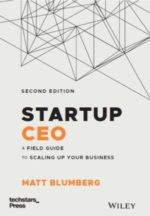
How to Start a Business, by Jason Nazar, CEO of our client Docstoc, is a great and quick (and free) eBook that feels a lot like a prequel to my book Startup CEO: A Field Guide to Scaling Up Your Business (original outline here). My book is about scaling a business once you’ve started it. Jason’s book is a really practical guide to starting it in the first place.
The thing that’s particularly good about this book is that it’s as much a resource guide as it is a book. At the end of each of its 24 chapters (and within them as well), Jason adds a series of external links to other resources, from videos to checklists to templates. The book answers a lot of really practical questions that are easy for product-focused entrepreneurs to gloss over or ignore, from corporate structures to insurance, from trademark registration to pitching VCs, from payroll to tax planning.
It’s great to see so much more being written for entrepreneurs these days. Ash Maurya’s Running Lean: Iterate from Plan A to a Plan That Works (which I blogged about last week) is another related book that focuses on how to bring a new product to market. But Jason’s eBook is a must read for anyone in TechStars or any accelerator program, or anyone contemplating starting a business.
Book Short: Best Book Ever
Book Short: Best Book Ever
The Hard Thing About Hard Things, by Ben Horowitz, is the best business book I’ve ever read. Or at least the best book on management and leadership that I’ve ever read. Period.
It’s certainly the best CEO book on the market. It’s about 1000 times better than my book although my book is intended to be different in several ways. I suppose they’re complementary, but if you only had time left on this planet for one book, read Ben’s first.
I’m not even going to get into specifics on it, other than that Ben does a great job of telling the LoudCloud/Opsware story in a way that shows the grit, psychology, and pain of being an entrepreneur in a way that, for me, has previously only existed in my head.
Just go buy and read the book.
Book Short: Wellness Redefined
Book Short: Wellness Redefined
Well Being: The 5 Essential Elements, by Tom Rath and Jim Harter from the Gallup organization, is a solid read and incredibly short. It’s one of those books that’s really a long article stretched and bound. But it goes beyond the basics of what I expected, which was something like “having healthy employees cuts down on absenteeism” and has a couple great elements of food for thought for leaders looking to build cutting edge and uber-productive organizations. It comes out of the same general body of research as four other very strong books I’ve written about over time — First, Break all the Rules, Now, Discover Your Strengths, 12: The Great Elements of Managing (book, review), and Go Put Your Strengths to Work (book, review).
The authors define well being as having five separate components: career well being, social well being, physical well being, financial well being, and community well being. Ok, that makes sense, but the three most interesting points the book made from my perspective were:
- Well being isn’t just about one of these five elements – it’s about all five, and how they interact together, and how the workplace can support all of them
- Achieving long-term objectives around well being requires finding short-term incentives that drive the same behavior in more obvious and immediate ways, as most long-term well being drivers require short term sacrifice. So figure out how to make eating a salad better for you not just years from now but TODAY (you’ll have more energy after lunch than if you eat that cheeseburger), for example
- Financial well being isn’t something a lot of companies focus on, and maybe it should be. Particularly in our industry we hire knowledge workers and assume therefore that they’re smart and educated about everything…but maybe there are ways that the company can support financial well being that aren’t necessarily obvious
The book is full of stats from the underlying research, most of which show that most people are shockingly unhappy, and that most workplaces dont do enough to support employee wellness. The book also notes, as is the case with most things, that promoting well being among employees requires more than just setting up programs. Doing it right requires constant vigilance, measurement, and follow up. At Return Path, we do a bunch of programs along the lines suggested by the book (but can and should do more!), but we’ve never been rigorous with follow up. Good food for thought.
Note there is also a free whitepaper on the economics of well being that you can download here. The white paper is ok…but not nearly as interesting as the book, and note that it does not substitute for the book. Thanks to my colleague Cathy Hawley for this book!
Book Short: Scrum ptious
Book Short: Scrum ptious
I just finished reading Scrum: The Art of Doing Twice the Work in Half the Time, by Jeff Sutherland and JJ Sutherland. This reading was in anticipation of an Agile Facilitation training my executive team and I are going through next week, as part of Return Path’s Agile Everywhere initiative. But it’s a book I should’ve read along time ago, and a book that I enjoyed.
Sutherland gets credit for creating the agile framework and bringing the concept scrum to software development over 20 years ago. The book very clearly lays out not just the color behind the creation of the framework, and the central tenets of practice again, but also clear and simple illustrations of its value and benefits. And any book that employs the Fibonacci series and includes Theodore Roosevelt’s “Man in the Arena” quote — my all-time favorite — is off to a good start by me.
I’ve always appreciated a lot of the underlying philosophy of Agile, such as regularly checking on projects, course correcting in response to feedback from customers or other stakeholders, and working hard to remove any impediments to progress in real time.
One of the author’s most poignant points is that “multitasking makes you stupid.” I hadn’t focused in the past how agile allows you to clear away context shifts to focus on one task at a time, but that’s another great take away from the book.
Our Agile Everywhere initiative, which is designed to improve productivity across the organization, as well as increase accountability through transparency, is even more critical in my view after having read this book.
The thing that I am left struggling with, which is still very much a work in progress for us, and hopefully something that we will address more head on in our training next week, is the application of the agile framework to teams that are not involved in the production of a tangible work product, such as executive or other leadership teams. That is something that our Agile Everywhere deployment team has developed a theory about, but it still hasn’t entirely sunk in for me.
I can’t wait for next week’s training session! If you have any experience applying the agile framework to different types of teams in your company I’d love to hear more about it in the Comments.
Book Short: Multiplying Your Team’s Productivity
Book Short: Multiplying Your Team’s Productivity
No matter how frustrated a kids’ soccer coach gets, he never, ever runs onto the field in the middle of a game to step in and play. It’s not just against the rules, it isn’t his or her role.
Multipliers: How the Best Leaders Make Everyone Smarter by Liz Wiseman and Greg McKeown (book, Kindle) takes this concept and drives it home. The book was a great read, one of the better business books I’ve read in a long time. I read a preview of it via an article in a recent Harvard Business Review (walled garden alert – you can only get the first page of the article without buying it), then my colleague George Bilbrey got the book and suggested I read it. George also has a good post up on his blog about it.
One of the things I love about the book is that unlike a lot of business books, it applies to big companies and small companies with equal relevance. The book echoes a lot of other contemporary literature on leadership (Collins, Charan, Welch) but pulls it into a more accessible framework based on a more direct form of impact: not long-term shareholder value, but staff productivity and intelligence. The book’s thesis is that the best managers get more than 2x out of their people than the average – some of that comes from having people more motivated and stretching, but some comes from literally making people more intelligent by challenging them, investing in them, and leaving them room to grow and learn.
The thesis has similar roots to many successful sales philosophies – that asking value-based questions is more effective than presenting features and benefits (that’s probably a good subject for a whole other post sometime). The method of selling we use at Return Path which I’ve written about before, SPIN Selling, based on the book by Neil Rackham, gets into that in good detail. One colorful quote in the book around this came from someone who met two famous 19th century British Prime Ministers and noted that when he came back from a meeting with Gladstone, he was convinced that Gladstone was the smartest person in the world, but when he came back from a meeting with Disraeli, he was convinced that he (not Disraeli) was the smartest person in the world.
Anyway, the book creates archetypal good and bad leaders, called Multipliers and Diminishers, and discusses five traits of both:
- Talent Magnet vs. Empire Builder (find people’s native genius and amplify it)
- Liberator vs. Tyrant (create space, demand the best work, delineate your “hard opinions” from your “soft opinions”)
- Challenger vs. Know-It-All (lay down challenges, ask hard questions)
- Debate Maker vs. Decision Maker (ask for data, ask each person, limit your own participation in debates)
- Investor vs. Micromanager (delegate, teach and coach, practice public accountability)
This was a great read. Any manager who is trying to get more done with less (and who isn’t these days) can benefit from figuring out how to multiply the performance of his or her team by more than 2x.